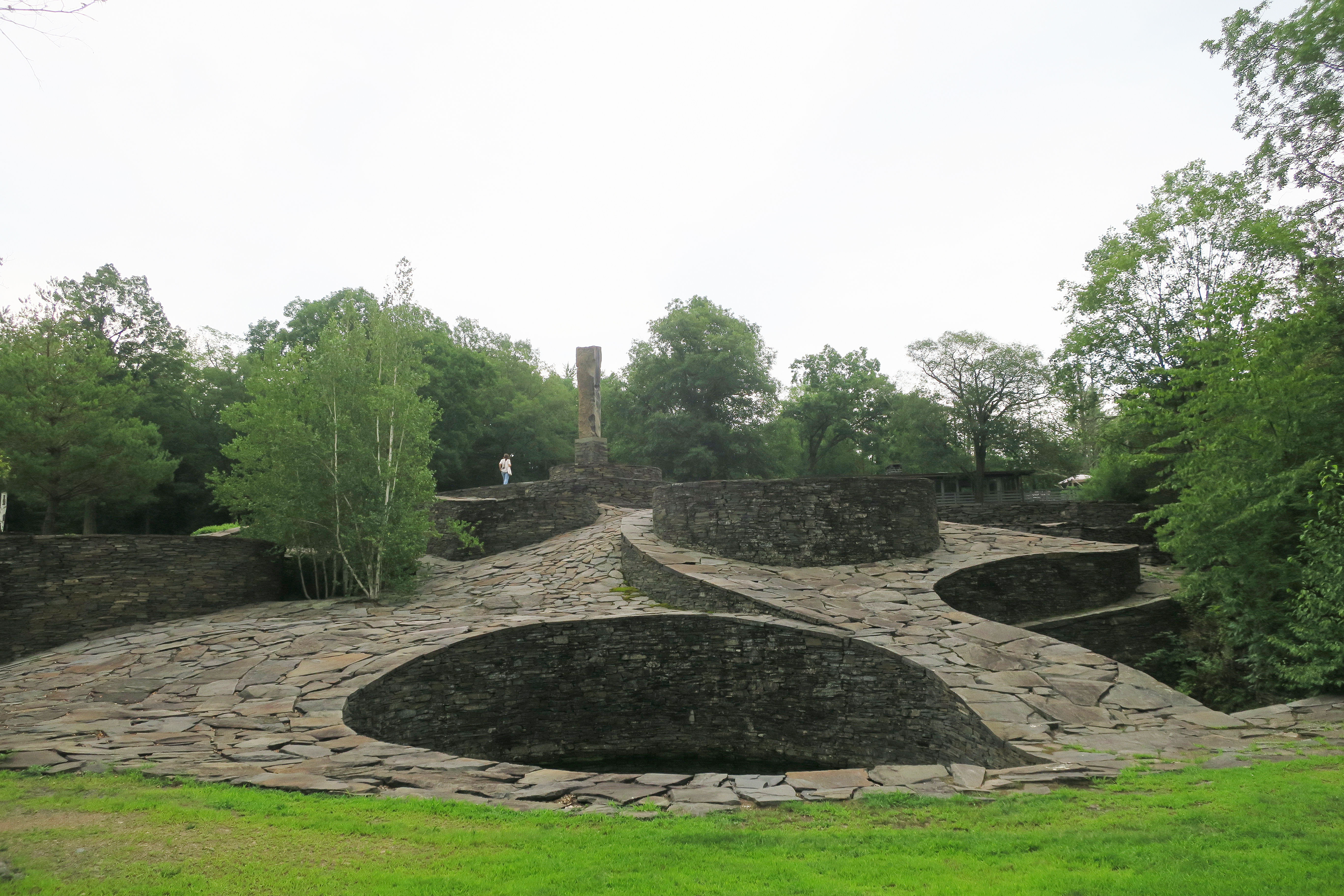
There is a place outside Saugerties, on a former bluestone quarry at the end of Fite Road, where a single man spent the better part of his life laying stone by hand. It is called Opus 40. It is six and a half acres of dry-laid bluestone — ramps, terraces, steps, fountains, pools, all fitted together without mortar — rising to a nine-ton monolith that has stood, held in place by nothing but its own weight and balance, since 1964.
It was built by Harvey Fite, alone, over thirty-seven years, with hand tools. It is one of the largest and least-categorizable works of art in the United States. And the most important thing about it is a reversal that happened in Fite's own mind in 1964 — the moment he understood that the thing he had built to display his sculptures had become the sculpture.
The man
Harvey Fite was born on Christmas Day, 1903, raised in Texas, and arrived at art by the least direct route imaginable. He studied law in Houston, abandoned it for the Episcopal ministry, won a scholarship to a seminary at Annandale-on-Hudson — and there, by his stepson's account, discovered sculpture backstage during a theater performance, when he absentmindedly pulled out a pocketknife and began whittling a discarded thread spool that had rolled under his chair.
He never went into the ministry. In 1933, the seminary — by then affiliated with Columbia and renamed Bard College — invited him back to found its fine arts program. He taught sculpture and theater at Bard until 1969. He was a direct-carving sculptor, working figures out of native bluestone.
In 1938 he bought a disused bluestone quarry outside Saugerties. He bought it for the raw material — he needed stone to carve. He had no plan, yet, to build what he built.
The Maya
The plan came from Honduras.
In the summer of 1938, the Carnegie Institution hired Fite as a "technical practitioner" to do restoration work on the Mayan ruins at Copán — the plazas, altars, and stairways of one of the great Maya sites. What Fite learned at Copán was dry-stone masonry: the Mayan technique of fitting cut stone into stable, mortarless structures worked into the natural topography, held together by gravity and precision alone.
He came home in 1939 and began organizing the rubble in his quarry — the waste stone the nineteenth-century quarrymen had left behind — using the technique he had learned from a thousand-year-old Central American civilization. No mortar. Hand tools. Stone fitted to stone.
The reversal
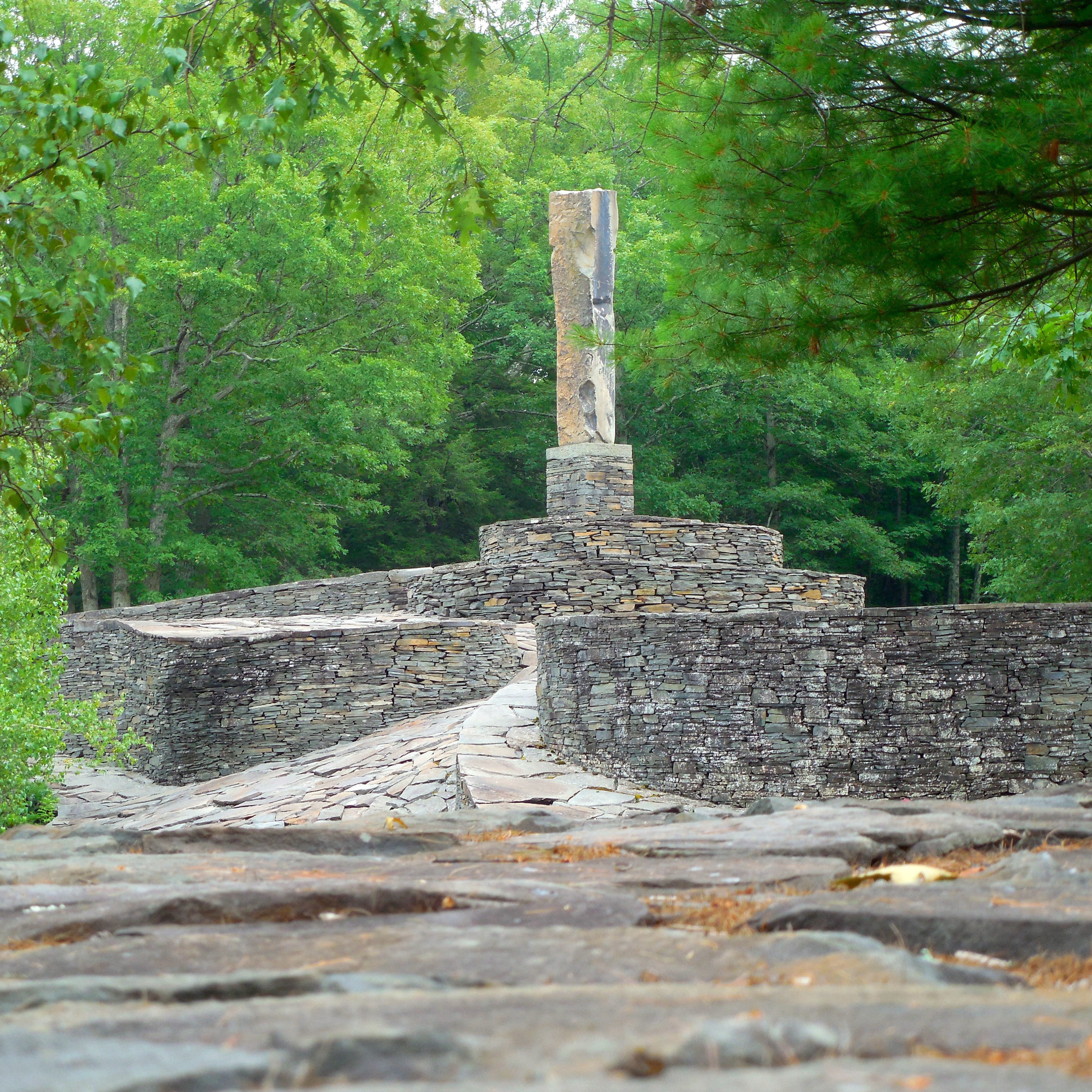
For twenty-five years, Fite built what he understood to be a setting — a vast bluestone platform, with ramps and pedestals and pools, designed as the backdrop and stage for his carved figures. The sculptures stood on the pedestals. A 1.5-ton carved piece called Flame stood on the central one. The stonework was the frame; the figures were the art.
Then, in 1964, twenty-five years in, he raised the monolith — a nine-ton bluestone column he had found in a nearby streambed, hoisted upright with a hand-built timber A-frame, block and tackle, logs, and a winch run off his pickup truck, set on a pedestal and held by its own weight, no mortar, where it still stands.
And when the monolith was up, Fite looked at the whole six-and-a-half-acre work and understood something that reorganized everything: what he had built as a setting had become a coherent sculpture in its own right — and in that sculpture, his carved representational figures were now out of place. The frame had become the art. The art he had made to put in the frame no longer belonged.
So he took the figures off. He removed his own sculptures from the pedestals he had built to hold them and relocated them to the surrounding grounds, at the edges. The pedestal had become the monument. The thing built to display the work had swallowed the work and become the masterpiece.
That is the reversal. That is the whole story of Opus 40 in one decision.
The name, and the forty years
He called it Opus 40. His own explanation: "Classical composers don't have to name things; they can just number them, Opus One, Opus Two, and so on." Opus is Latin for "work." The 40 was his estimate of how many years it would take him to finish.
He did not get forty. On May 9, 1976 — in the thirty-eighth year — Harvey Fite died in an accidental fall on the site he had spent half his life building. His stepson Jonathan Richards put it exactly right: "Opus 40 is as complete as it ever would have been. It was the product of Fite's ceaseless vision, and could only have been stopped by his death."
What it is now
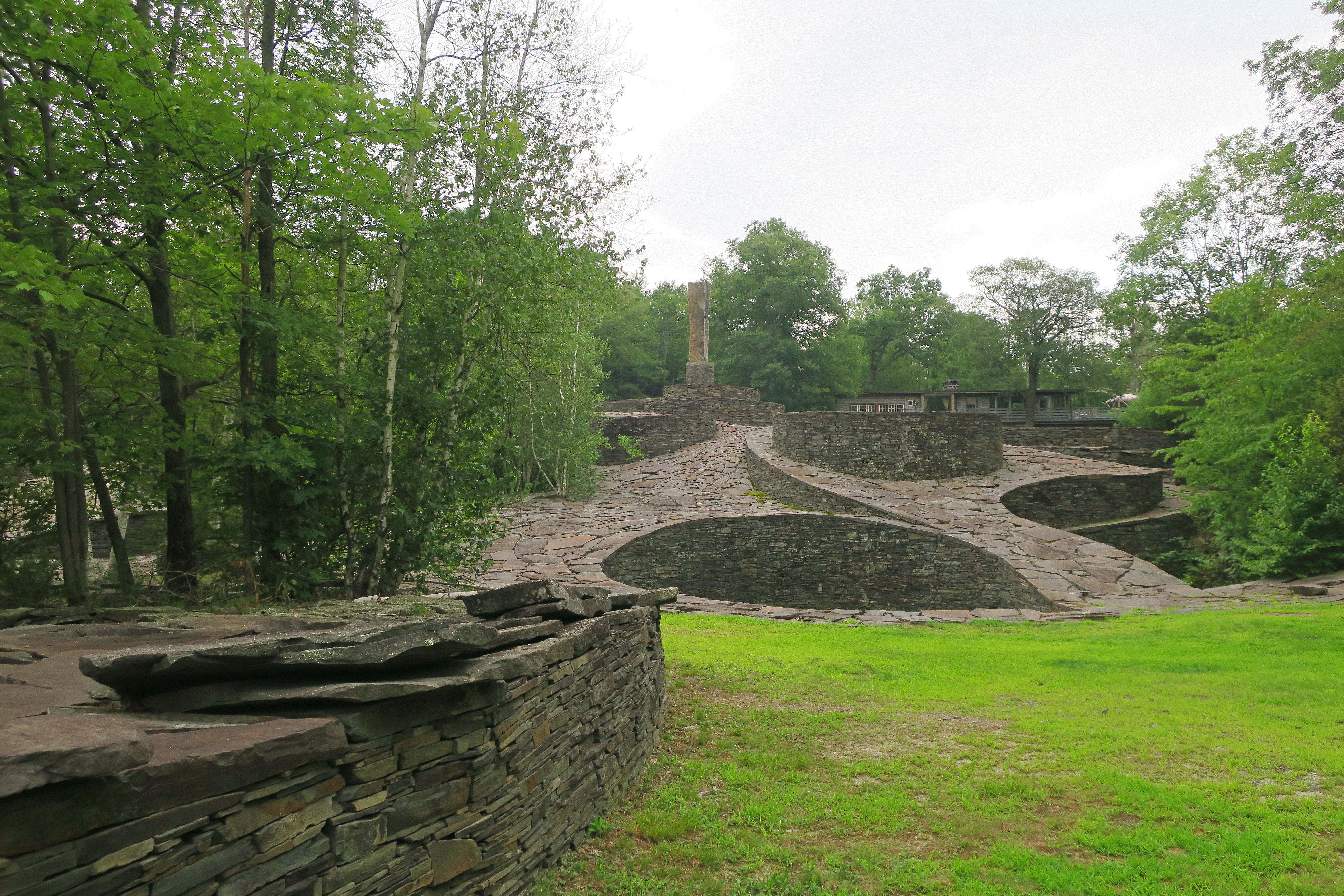
Fite's widow, Barbara Fite — his close aesthetic collaborator — established the nonprofit in the late 1970s and opened the grounds to the public. The site was listed for sale at $3.5 million in 2010, and there was a real fear it would become a private estate and be lost to the public; it survived as the nonprofit. It was added to the National Register of Historic Places in 2001.
Today Opus 40 is open seasonally (roughly April through November), hosts a summer concert series amid the bluestone ramps — ten-some concerts a season, programmed with the Saugerties arts organization The Local — plus nature walks, workshops, and weddings. On the grounds is the Quarryman's Museum, which Fite built to hold the hand tools and folk artifacts of the regional bluestone industry: a museum of the industry, on the site of the industry, inside an artwork made from the industry's leftovers.
The precursor
Here is the art-historical fact that should make Opus 40 more famous than it is.
Fite began Opus 40 in 1939. The land-art / earthworks movement — Robert Smithson's Spiral Jetty, Michael Heizer's desert excavations, the whole canonical moment of artists working at landscape scale in the American environment — did not begin until the late 1960s and 1970s. Smithson built Spiral Jetty in 1970, thirty-one years after Fite started laying bluestone. Art in America called Opus 40 "a kind of unintended precursor to Robert Smithson's Spiral Jetty." The Smithsonian's Hirshhorn included Fite in its 1977 earthworks exhibition as a forefather of a movement that postdated him by three decades.
The critic Brendan Gill — writing in Architectural Digest in 1989 — called Opus 40 "one of the largest and most beguiling works of art on the entire continent... a cousin of Stonehenge and the long since vanished Hanging Gardens of Babylon."
Fite was not part of a movement. He was a Bard professor obsessively laying stone in a quarry, and he got to land art thirty years before land art, alone, without a manifesto, and never called it that.
What "the pedestal that became the monument" means
The argument is about the relationship between the setting and the thing.
Most of what we build, we build to hold or display or frame something else. The pedestal exists for the sculpture. The building exists for its function. The setting is in service to the thing it sets. The setting is supposed to recede — to be the quiet support that lets the real subject stand out.
Opus 40 is the rare, clarifying case where the setting, pursued with enough obsession and for enough years, became more important than the thing it was built to serve — and the maker had the honesty to recognize it and act on it. Fite did not force his figures to stay on pedestals that had outgrown them. He saw that the frame had become the art, and he removed the art to honor the frame. That is an almost unheard-of act of clarity about one's own work.
It is also, quietly, a lesson about effort. Thirty-seven years of one man's hand-laid stone produced something that no committee, no budget, no plan could have produced — because the thing that makes Opus 40 great is precisely the obsessive, single-handed, decades-long quality of its making. You cannot fund it into existence. You can only build it, by hand, for thirty-seven years.
What the rest of the valley can learn
Three things.
One. The setting, pursued far enough, becomes the subject. The Hudson Valley is full of settings built to frame something else — gardens, grounds, landscapes, structures. Occasionally, with enough sustained attention, the setting becomes the masterwork. Opus 40 is the proof. It takes decades and one obsessive maker.
Two. Honesty about your own work is rare and valuable. Fite's willingness to remove his own sculptures — to admit that the thing he'd built to display them had made them unnecessary — is the move most makers cannot make. The valley's best work comes from people willing to follow the work where it actually went, not where they planned for it to go.
Three. Some things can only be made by hand, over a lifetime. Opus 40 cannot be reproduced, franchised, or accelerated. Its greatness is inseparable from the thirty-seven years and the single pair of hands. In an era of scale and speed, the valley's most singular asset is exactly this kind of slow, unrepeatable, hand-made work.
Go, then come back
Opus 40 is at 50 Fite Road, Saugerties (confirm seasonal hours before you go). Walk the bluestone ramps. Stand at the base of the monolith and do the arithmetic — nine tons, no mortar, raised by one man with a winch and a pickup truck in 1964, still standing. Find Fite's carved figures relocated at the edges, where he moved them. Visit the Quarryman's Museum. Time a summer evening for a concert on the stone. Pair it with the broader Saugerties bluestone story, which is where this one sits.
Then drive home and look at the settings around you — the gardens, the grounds, the frames built to hold something else — and ask: has any of these, pursued long enough, become the thing itself? That is the case for Opus 40. And, quietly, it is the case for everywhere in the valley where decades of one person's hands made something no plan could have.
— The Editors