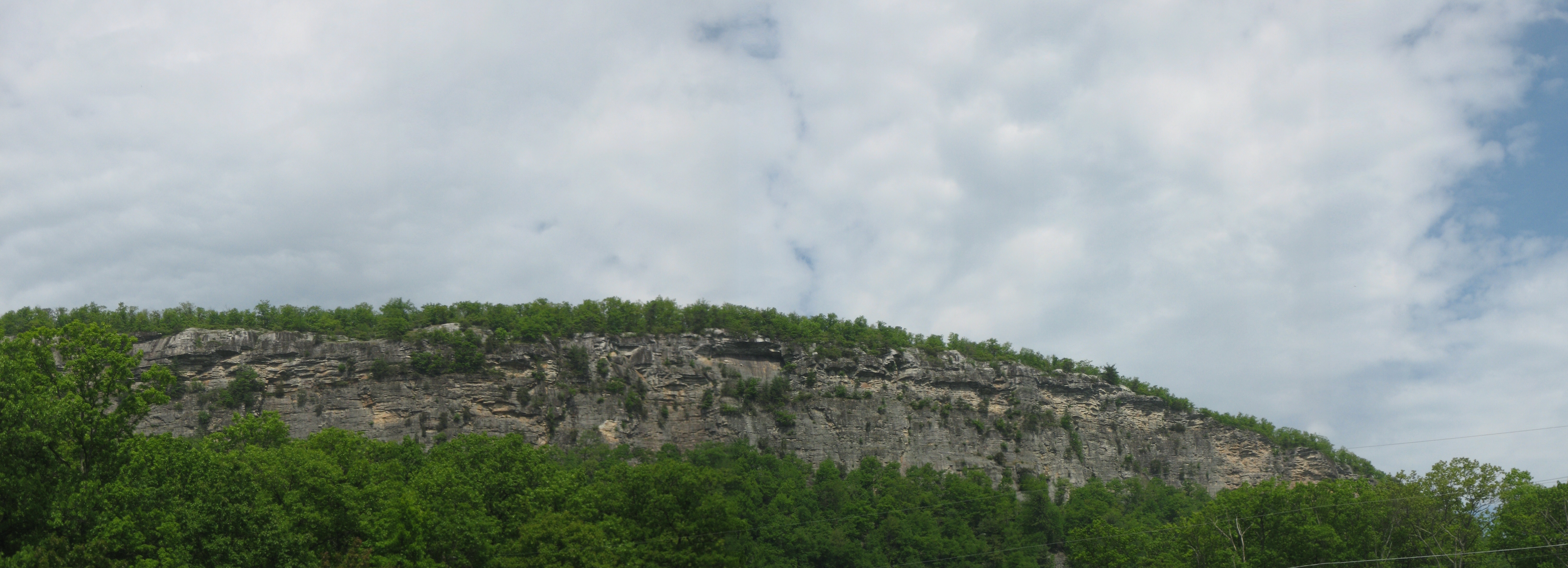
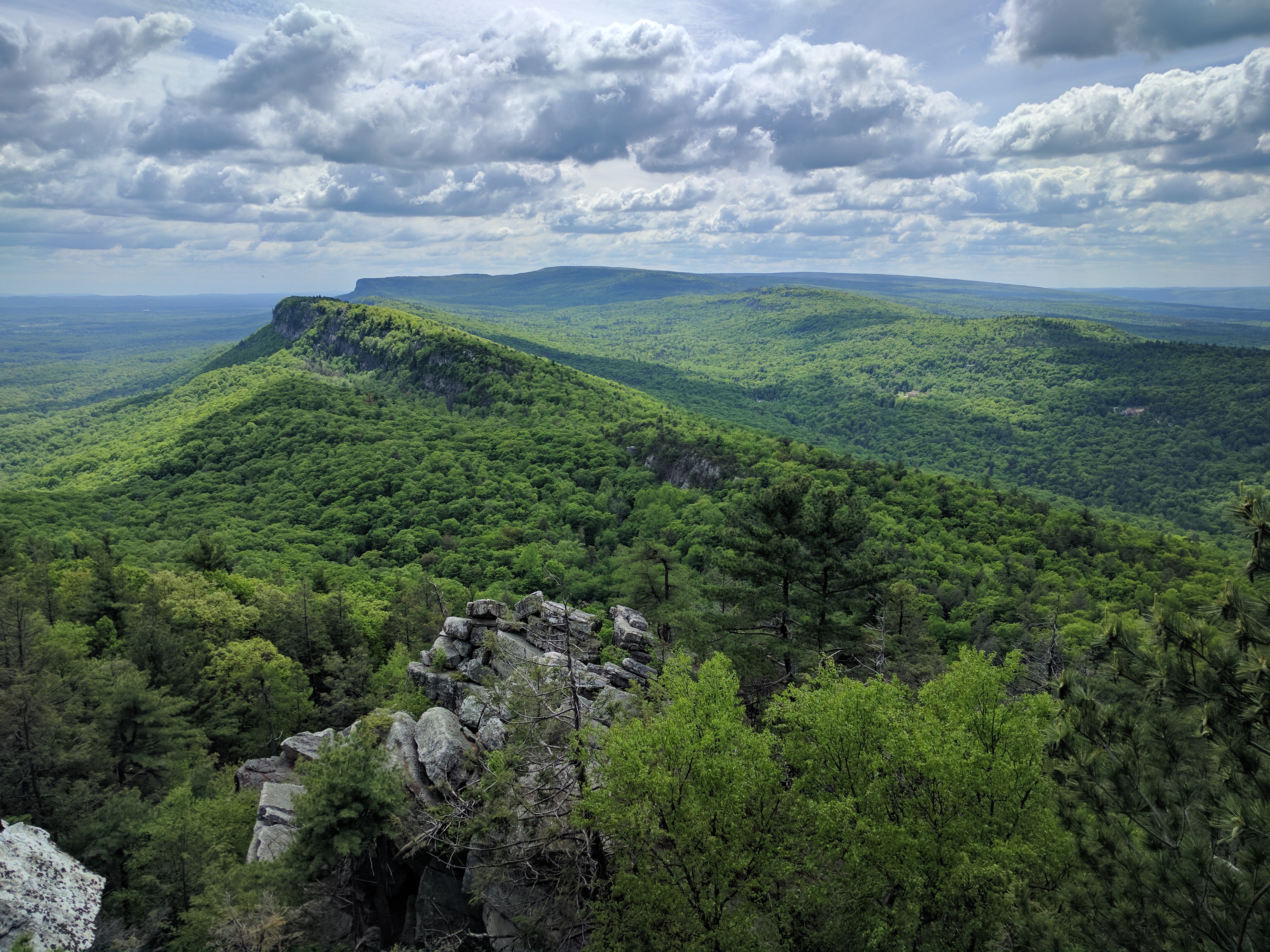
The Shawangunk Ridge runs north-south for ninety miles down the eastern edge of the Catskills, but the part of it that matters here is a roughly fifteen-mile stretch above the village of New Paltz, where the ridge climbs out of the Wallkill Valley and tips white-quartz cliffs into the sky. The rock is Shawangunk conglomerate — Silurian, four hundred and thirty million years old, gravel and sand cemented in a matrix of pure quartz. On a clear afternoon, the cliffs gleam. Climbers from the Eastern Seaboard know the names of the formations the way other people know the names of saints: the Trapps, Sky Top, Millbrook, the Near Trapps. The ridge is, by the relevant superlatives, the East Coast's defining climbing wall.
It is also, by another relevant superlative, the largest nonprofit nature preserve in New York State — over 8,000 acres, held in perpetual trust by a 501(c)(3) land trust called the Mohonk Preserve.
It got that way because of one family. Six generations of them.
The lake, and the twins who walked up to it
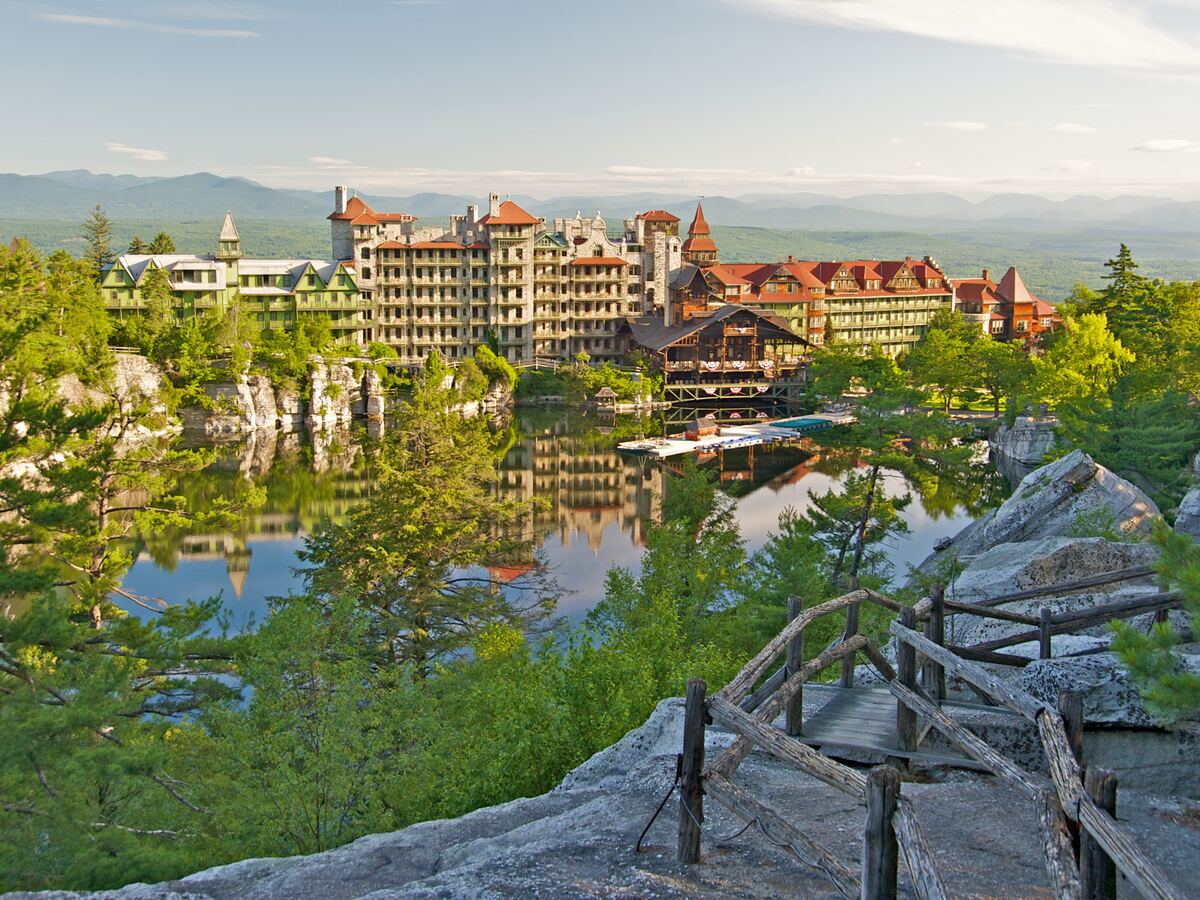
In September of 1869, a forty-one-year-old Quaker schoolteacher named Alfred Smiley was walking through the Shawangunks with his brother-in-law when he came over a rise and saw a small mountain lake — black water in a granite bowl, surrounded by white cliffs. He went home to Poughkeepsie and told his twin brother, Albert Keith Smiley, that he had to see it.
The brothers were forty-one, identical twins, born March 17, 1828, in Vassalboro, Maine, into a Quaker family of farmers and teachers. They had been running a boys' school in Poughkeepsie. By the end of that fall, Albert had bought the ten-room Stokes Tavern at the edge of the lake from a man named John F. Stokes for $28,000 — Stokes had asked $40,000; Albert talked him down — along with three hundred acres of the surrounding ridge.
The next summer, the Mohonk Mountain House opened. By 1870 standards it was a modest hotel. Plain rooms. No alcohol, no cards, no dancing — Quaker terms. The brothers ran it together, walked the cliffs together, and within a decade had begun to build something stranger than a hotel: a network of carriage roads along the ridge, hand-graded into the rock, designed so that guests on horseback or in coaches could traverse the entire upland without ever steepening above a five-percent grade. The roads were beautiful, and they were also a kind of moral architecture. They made the ridge available without altering it.
By the time Albert died in 1912, the Smiley family owned and managed a working luxury resort, a private working ridge, and an unusual amount of carriage-graded landscape that they were already letting outsiders use, with permission, for very little money.
February, 1963
Fast-forward fifty-one years.
On February 26, 1963, Albert's nephew A. Keith Smiley — son of Albert's younger half-brother, the original Daniel Smiley, who had managed the Mountain House in the second generation — sat down with his brother Daniel (the younger Daniel, the naturalist) and a group of family members and friends, and signed the founding papers of the Mohonk Trust. The Trust's seed fund was a gift of one hundred dollars from their aunt, Mabel Craven Smiley.
The mechanism the Smileys had built was simple and irrevocable. The family was not promising not to sell the ridge. They were conveying the ridge — the majority of the surrounding land the family then owned — out of family ownership and into a perpetual nonprofit trust. The conveyance is the part that mattered. In one stroke, the land could no longer be sold by anyone, including future Smileys.
The Mountain House — the working resort, profitable, still owned by Smiley Brothers, Inc. — stayed in the family. The cliffs and the carriage roads and the upland forests did not. That separation is the through-line of the whole story: the family kept the business; they gave away the ground.
In 1979, sixteen years in, the Trust won a landmark New York Court of Appeals decision — Mohonk Trust v. Board of Assessors of the Town of Gardiner — that established that a private conservation nonprofit holding land for public benefit could retain tax-exempt status under New York law. That ruling is still cited by land trusts across the state today. In 1981 the Trust reorganized, renamed itself Mohonk Preserve, Inc., and named its first executive director.
The mountain belonged to no one. Which is to say, it belonged to anyone who would walk it.
The climbers
In September of 1935 — twenty-eight years before the Trust existed, but on land the Smileys already owned and were already letting outsiders use — a German-American climber named Fritz Wiessner was standing on Breakneck Ridge across the Hudson, looking west, and noticed a flash of white on a far ridge that he could not identify. It was Shawangunk quartz, catching afternoon sun. He came back the next weekend with two companions, John and Peggy Navas, and established the first technical climbing route in the Gunks — a 5.5 on Millbrook Mountain. The route still exists. It's still climbed.
In 1941, Wiessner returned with an Austrian physician named Hans Kraus — later, in a separate professional life, John F. Kennedy's secret personal physician for back pain — and put up High Exposure on the Trapps with hemp rope and three soft iron pitons. High Exposure is rated 5.6. By any honest accounting, it is one of the most famous climbing routes in the world at that grade. Generations of East Coast climbers have done it as a coming-of-age route.
Through the late 1950s, Wiessner and Kraus would establish 56 of the 58 multi-pitch climbs put up in the Gunks. The two of them, between them, are essentially why East Coast rock climbing exists.
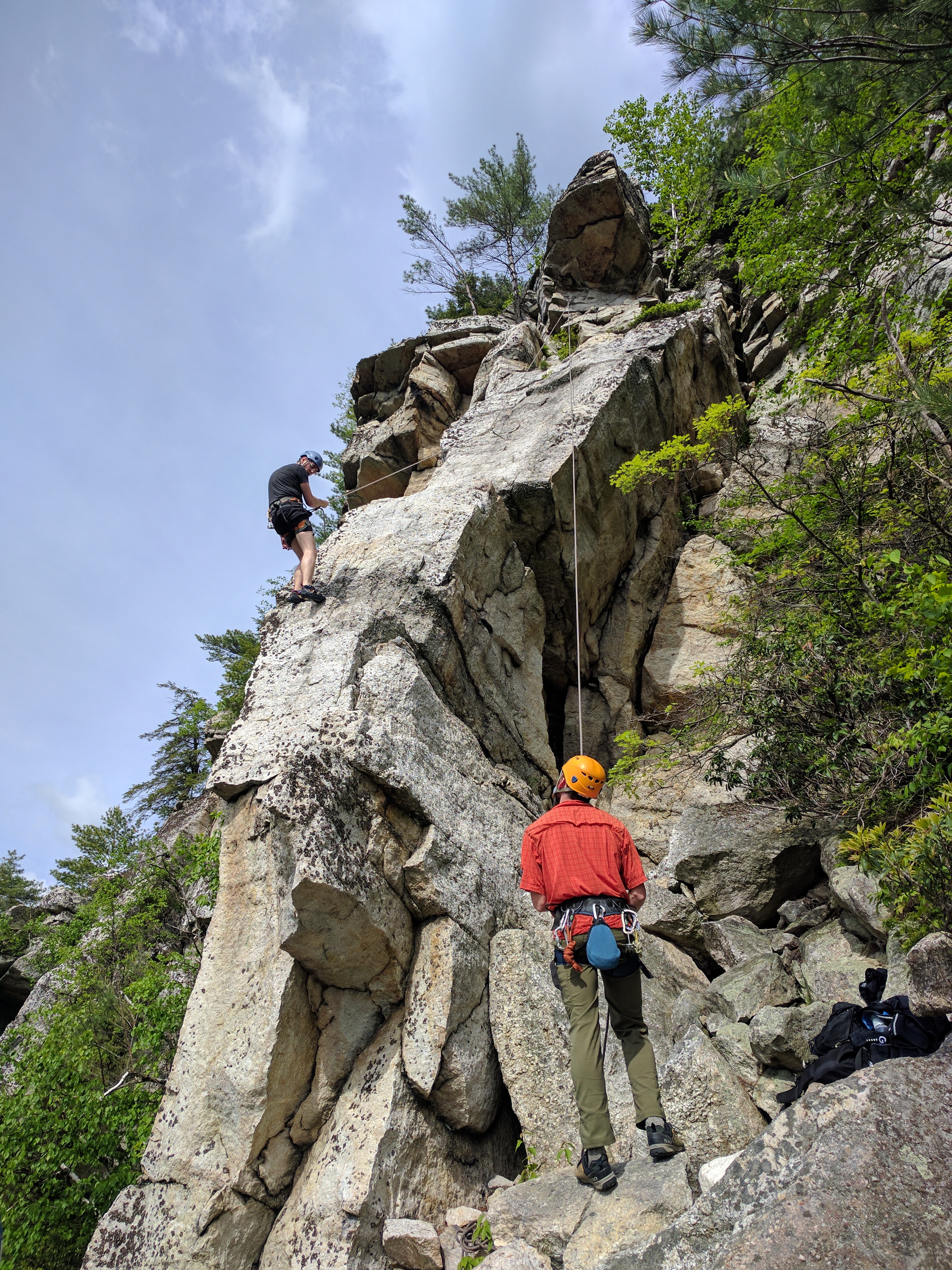
Today the Preserve carries more than 800 climbing routes on its cliffs. More than 100,000 climbers make the pilgrimage each year. About 300,000 visitors in all — climbers, hikers, photographers, schoolchildren on field trips, ornithologists tracking the cliffs' nesting peregrine falcons. The carriage roads the Smileys hand-graded in the 1880s are now the trail spine. More than seventy miles of carriage road and trail. All of it on land that could, in a different family, have been a subdivision.
What got built on land that wasn't sold
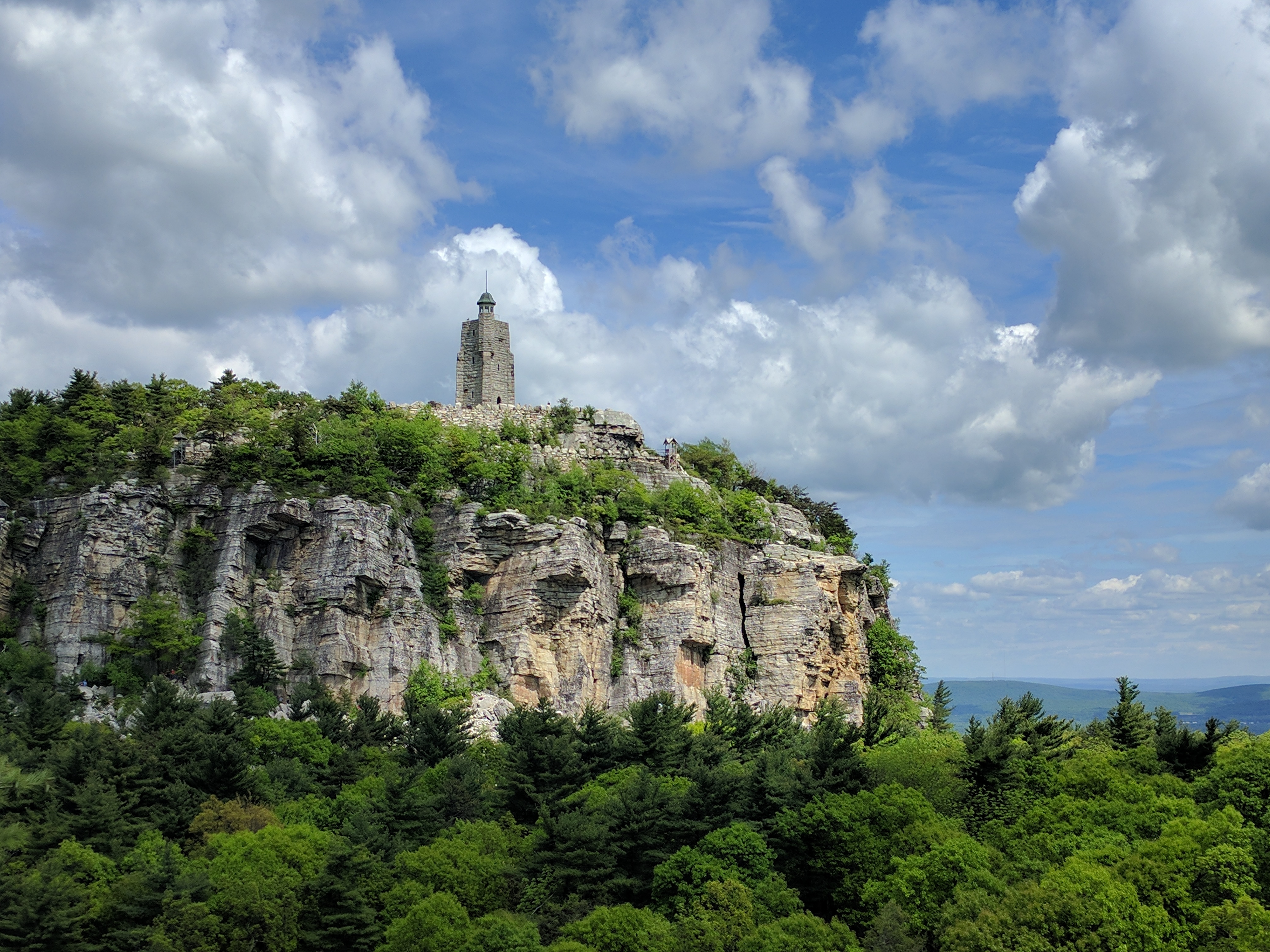
The mathematics of not selling is hard to see, because it produces an absence. There is no subdivision on the cliffs of the Trapps. There are no second homes terraced down Sky Top. There is no gated community at Lake Mohonk. None of those things exist. The land instead carries seventy miles of carriage road and trail, the dwarf pitch pine barrens that make the ridge globally rare, the Albert K. Smiley Memorial Tower at the summit of Sky Top — a stone monument the family put up in 1923 to honor the founder, twelve years after he died — and a century and a half of human attention paid carefully to a place that doesn't need any.
The Preserve has since become a kind of conservation hinge for the entire northern Shawangunk Ridge. In 2011, the Open Space Institute acquired 874 acres from the Smileys' resort company and conveyed the additional land into protection. In 2014, the Preserve purchased the 857-acre Foothills property from OSI to extend protection west. South of the Preserve, the 12,000-acre Minnewaska State Park Preserve runs the ridge into New York State stewardship. Combined, the protected ridge runs to more than 35,000 contiguous acres of cliff, forest, and rare community type.
It is, today, the largest contiguous protected landscape in New York's mid-Hudson region. It exists because in February of 1963, two brothers and a hundred-dollar gift built a structure designed to outlast its founders.
The longer arithmetic
The Smileys could have sold the ridge.
This is the line the whole story bends around. In 1869 they could have flipped the Stokes Tavern for a quick profit, the way most nineteenth-century hotel-keepers did. In 1912, when Albert died, the family could have liquidated his holdings. In 1963, instead of conveying the upland into trust, A. Keith Smiley and his brother could have sold it to a developer and lived comfortably on the proceeds for several generations. In 1981, when the Trust was reorganized, the family could have folded the experiment quietly back into resort assets. In 2011, when Smiley Brothers Inc. transferred those 874 acres to OSI, the family could have held them and sold them at a higher rate later.
None of those things happened. And the not-happening is the whole story.
What the Smileys built in February of 1963 was not a refusal to sell. It was an institution that could not. The perpetual conservation trust is a legal architecture that takes the question of selling off the table — out of the hands of any single generation, out of the reach of any future heir who might be tempted, out of the orbit of any political climate or economic cycle. The 1979 Court of Appeals ruling sealed the architecture against tax challenges. The Open Space Institute partnerships extended it beyond Smiley land. Six generations of one Quaker family used the legal system to make irrevocable what every generation before them had instead made promises about.
The Mountain House still operates as a working luxury resort, owned by Smiley Brothers, Inc., at the edge of Lake Mohonk. You can stay there. You can have dinner there. The hotel kept its commerce.
The ridge above it, though — the white cliffs of the Trapps, the seventy miles of carriage road and trail, the Sky Top tower, the climbing routes Fritz Wiessner put up before the war, the dwarf pitch pines, the peregrines — belongs to no one. Which is to say, it belongs to anyone who walks it. Which is to say, it belongs to everyone who has walked it for sixty-three years, and to everyone who will walk it for as long as the institution holds.
A hundred dollars and the right paperwork, in February of 1963.
That's the case for the ridge the Smileys would not sell.
— The Editors