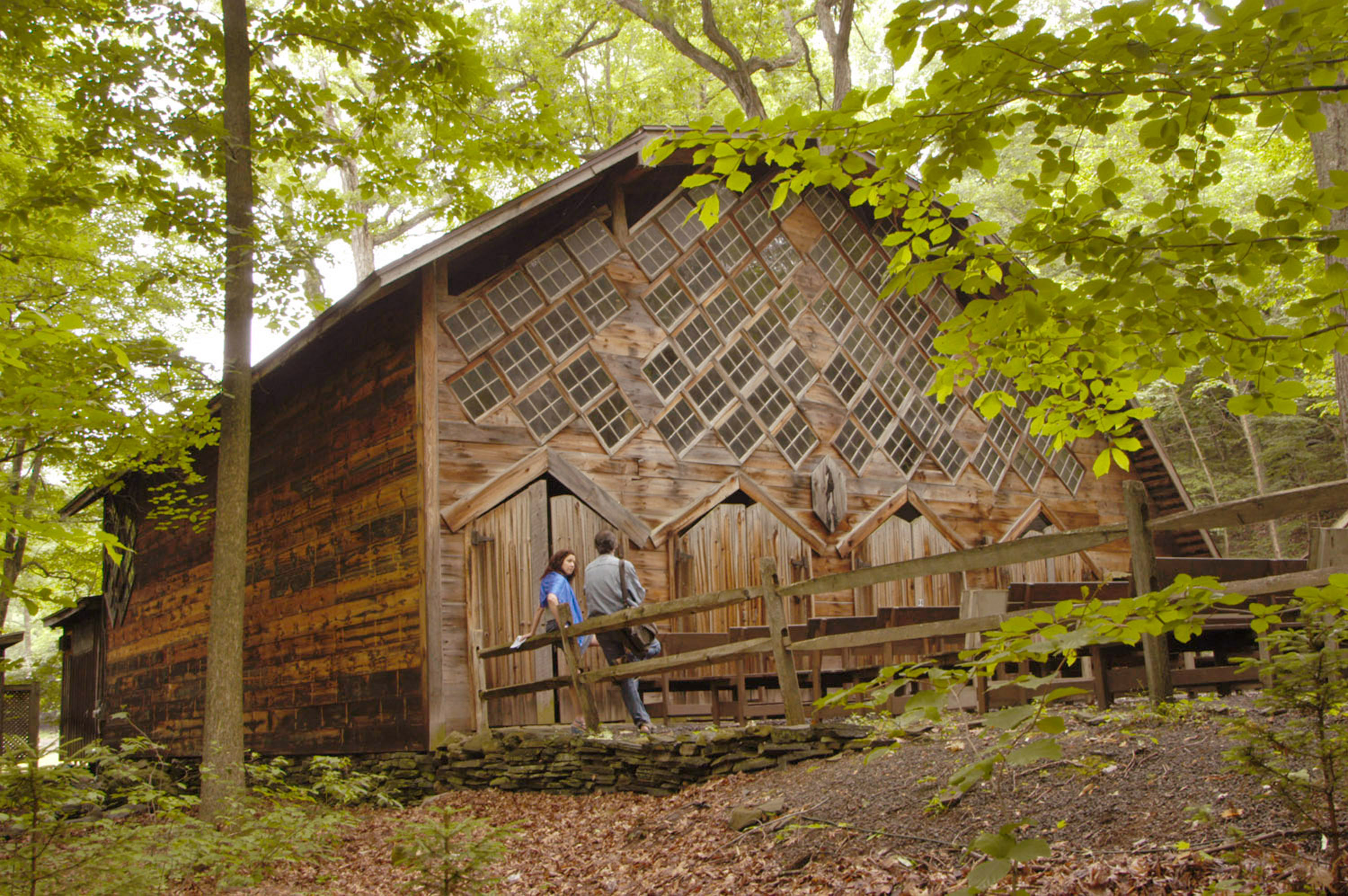
On a Friday afternoon in August 1952, in a hand-built rustic barn at 120 Maverick Road just outside the village of Woodstock, the pianist David Tudor walked onto a stage, sat at the piano, and did not play a note for four minutes and thirty-three seconds. The piece was John Cage's 4'33", and that was its world premiere. The audience could hear the wind, the trees, the chairs, themselves. The audience left, in a great many cases, irritated; some left thinking that they had been part of one of the most important things to happen in twentieth-century music. Both readings were correct.
The barn that hosted Cage's premiere had been hand-built in 1916 by Hervey White — a Harvard-educated socialist, writer, and printer who, in the words of one contemporary, had "a genius for friendship" — and a small group of arts-colony peers, with no architect, on volunteer labor, with the timber and nails of a working farm. The hall was, and is, the home of Maverick Concerts, which has been running continuously since 1916 and is the oldest continuously running summer chamber music festival in the United States.
In 2026, Maverick will run its 110th season.
That is the kind of town Woodstock has always been. The town the world thinks it knows is somewhere else.
Byrdcliffe (1902)
The arts colony at the foot of Overlook Mountain came first.
In 1902, Ralph Radcliffe Whitehead, Jane Byrd McCall Whitehead, Bolton Brown, and Hervey White — three of them with money, all four with a deep commitment to the Arts and Crafts movement that had been moving through England under Ruskin and William Morris a generation earlier — bought a 1,500-acre tract on the slopes above Woodstock and founded Byrdcliffe. The colony was, in Whitehead's framing, "an experiment in utopian living" — a working community of weavers, potters, woodworkers, painters, and printers, organized around the principle that handcraft was the necessary response to industrial standardization. The colony's motto was "head, heart, and hand."
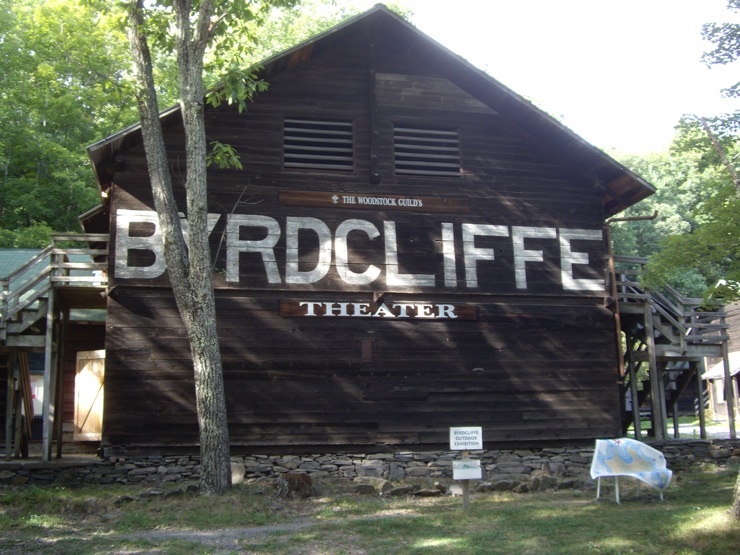
Byrdcliffe is the oldest continuously operating arts and crafts colony in America. Thirty-five original Arts and Crafts–style buildings still stand on the 300-acre operating campus. White Pines, Whitehead's residence with its skylit cathedral-ceiling weaving room, remains. So does the Villetta Inn, built in 1903 as the colony's boarding house and now the home of Byrdcliffe's artist-in-residence program — seventy-five-plus artists across four summer sessions every year.
Bolton Brown left Byrdcliffe in 1905 with Hervey White; they found Whitehead's structured, top-down approach too rigid. White bought 102 acres on the other side of the village, founded the Maverick colony as a more democratic, bohemian alternative, and built that barn in 1916.
That is how Woodstock acquired two arts colonies, side by side, before Joseph Stalin had taken power.
What it has been ever since
Byrdcliffe and Maverick set the pattern. Everything that has happened in Woodstock since has happened inside it.
1919: The Woodstock Artists Association and Museum — still on Tinker Street — was founded as the formal exhibiting body for what was, by then, a working colony of painters. Milton Avery, George Bellows, Philip Guston are connected to the broader Woodstock arts ecosystem through WAAM and through Byrdcliffe across the early-to-mid twentieth century.
1952: Cage's 4'33", premiered at the Maverick. (Paul Robeson sang there too. Aaron Copland was a regular. The list is long.)
1967: Rick Danko, Garth Hudson, and Richard Manuel — three musicians who would, with Robbie Robertson and Levon Helm, become The Band — rented a pink-sided ranch house at 56 Parnassus Lane in West Saugerties, the next town over. With Bob Dylan, who had moved to the area after his 1966 motorcycle accident, they recorded what would become known as the Basement Tapes in the basement of the house through the summer and fall of 1967. Music From Big Pink, The Band's debut, came out in 1968. "The Weight" was on it.
1969: The festival the world calls Woodstock happened on Max Yasgur's dairy farm in Bethel, NY — Sullivan County, sixty miles southwest of the actual town of Woodstock. Three earlier sites had fallen through, including one in Woodstock itself (the residents declined) and one in Wallkill (the town board passed an ordinance restricting gatherings of more than five thousand). Producer Michael Lang found Yasgur's farm at the last minute. The festival went on. Bethel Woods Center for the Arts sits on the site today and is, by every measure, an excellent institution. None of that is the town of Woodstock. Woodstock and Bethel are both Hudson Valley places. The festival just happened on Yasgur's land.
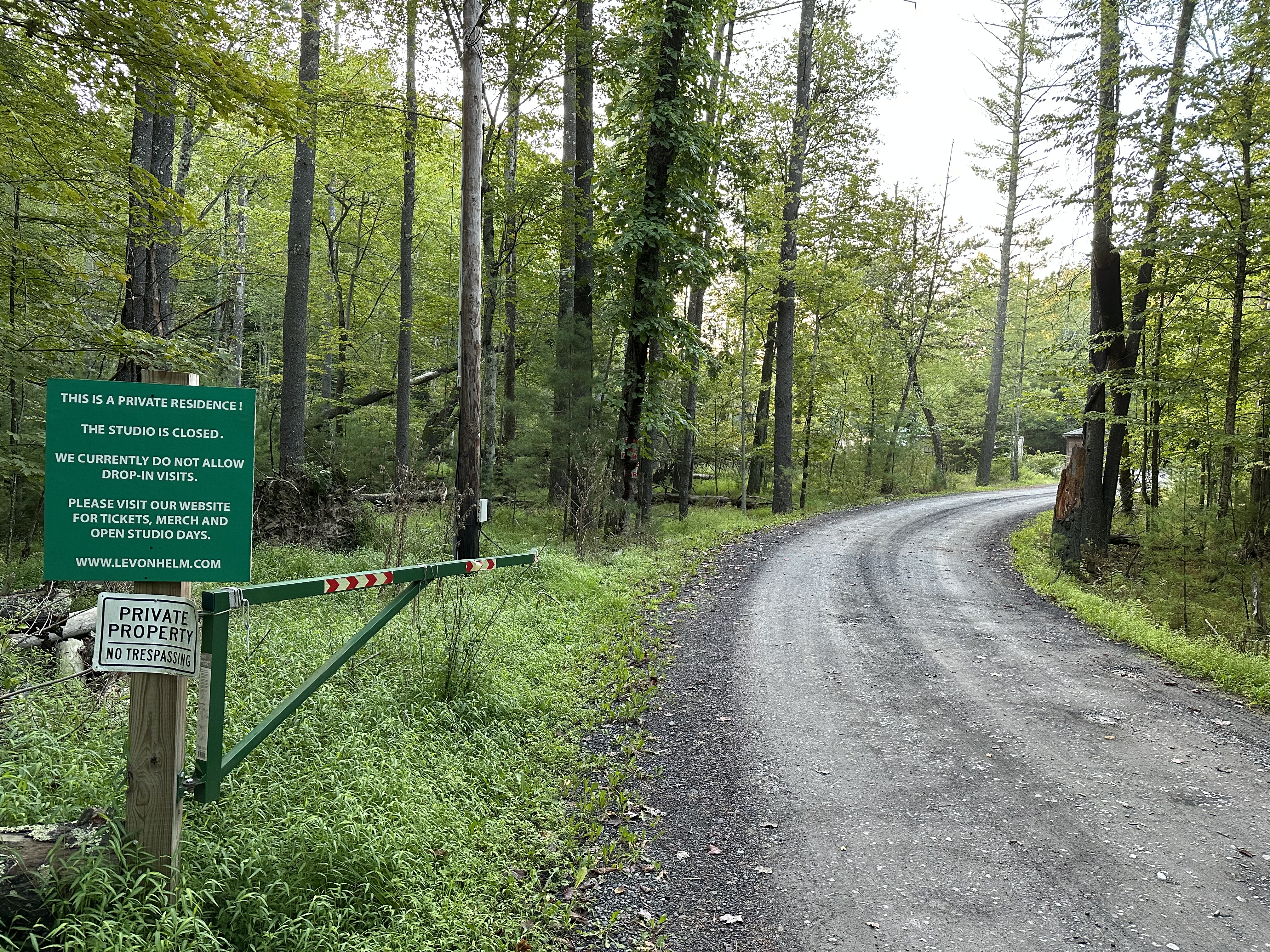
1975: Levon Helm built the Barn at 160 Plochmann Lane in Woodstock, acoustically engineering it himself with hemlock, pine, and bluestone. He lived in Woodstock from the late 1960s until his death on April 19, 2012. In the 2000s, after a cancer diagnosis, he started the Midnight Ramble — informal Saturday-night concerts at the Barn — partly to pay medical bills, partly because he wanted to play in front of people again. The Ramble became a national institution. His daughter Amy Helm runs it now. The Helm Family Midnight Rambles continue. The Barn is still on Plochmann Lane.
2000: The Woodstock Film Festival was founded. The 27th Annual runs October 14–18, 2026.
Today: The Golden Notebook, an independent bookstore at 29 Tinker Street, has been open since 1978 — Lydia Davis, Neil Gaiman, Steve Earle, William Kennedy, Paul Muldoon, and Cheryl Strayed have all read there. The Woodstock Playhouse is a designated site of the Hudson River Valley National Heritage Area for its place in American theater. Bearsville Theater and Bearsville Studios — Albert Grossman's complex from the 1970s, where Grossman managed Dylan, The Band, Janis Joplin — is still operating. Cucina on Mill Hill Road, opened 2006 by Chef Gianni Scappin, is the kind of restaurant that runs for twenty years. Oriole 9, Joshua's Café, Yum Yum Noodle Bar, Garden Café, the reimagined Bear Café in Bearsville — the working ecosystem of a small town that has been an arts town for a hundred and twenty-five years.
The Center for Photography at Woodstock — founded in Woodstock in 1977, with a long-running residency program — outgrew the village in 2022 and now anchors a new chapter in Kingston at 25 Dederick Street, in the former Van Slyke cigar factory. The institution moved. The institution did not stop. Continuity through change is what an arts town actually looks like over a hundred years.
What "stayed itself" means
The argument is simple.
Most American small towns that became famous because of a single moment lost their practice in the gravity of the moment itself. The town becomes a destination for the moment. The shops sell merchandise of the moment. The restaurants serve themed food. The town's actual cultural production — the working studios, the hand-built halls, the long residency programs — gets buried under T-shirts and tours.
Woodstock is the inverse. The 1969 festival happened to a different town. The actual town of Woodstock — the Woodstock, the one with the green and Tinker Street and the colony in the hills — was already an arts town in 1969 by sixty-seven years. It is one now by a hundred and twenty-five.
That is not a story you can manufacture. It is a story you can only inherit, and then keep doing.
The colonies kept running. The Maverick kept booking concerts. WAAM kept exhibiting. The bookstores kept opening. The Helms kept playing. The Film Festival kept running. The CPW moved to Kingston and kept its program. Each generation of operators has done their own version of what Whitehead and White did at the start. That is what the town's continuity is made of.
What the rest of the valley can learn
Three things.
One. A town's identity is what it has been practicing, not what it became famous for. The towns the Hudson Valley should look at as models are towns that have been operating something for fifty or a hundred years. Continuity is the unit of cultural value, not virality.
Two. Founders don't have to scale, but the institutions they leave behind have to adapt. Byrdcliffe is the form Whitehead built. Maverick is the form White built. Both are now run by people who never met them. The forms hold because each generation has kept the form working — moved the operations, swapped the buildings where needed, kept the schedule. The institution is the inheritance, not the founder.
Three. The Hudson Valley has more 1900s arts-colony heritage than it knows what to do with. Most of it has lapsed. The towns that have kept their colonies running are doing something most of the rest are not. Maverick. Byrdcliffe. The Hudson Valley has the building stock and the legacy and, in many cases, the heirs of comparable institutions still living locally. The question is whether anybody has been keeping the schedule.
Go, then come back
Woodstock is roughly two hours from Manhattan. Drive in on Tinker Street through the village — past WAAM, Golden Notebook, the green where Mill Hill, Tinker, and Rock City converge. Walk Byrdcliffe: the colony does periodic open-house tours of White Pines, the Villetta, and the surviving studios. Drive up to Maverick at 120 Maverick Road on a Sunday afternoon in summer for a chamber concert — the same hall Cage premiered in. Drive up Plochmann Lane if there is a Midnight Ramble on the calendar — book ahead. Walk Overlook Mountain from the trailhead on Meads Mountain Road; the trail passes the ruins of the Overlook Mountain House before reaching the summit fire tower at 3,136 feet. Eat at Cucina, Oriole 9, the Bear, the Garden.
Then drive home. Look at any town in the valley you happen to pass through and ask: what has this town been practicing for a hundred years? That is the case for Woodstock. And, quietly, it is the case for everywhere in the region that has stayed itself long enough to inherit what it has been all along.
— The Editors