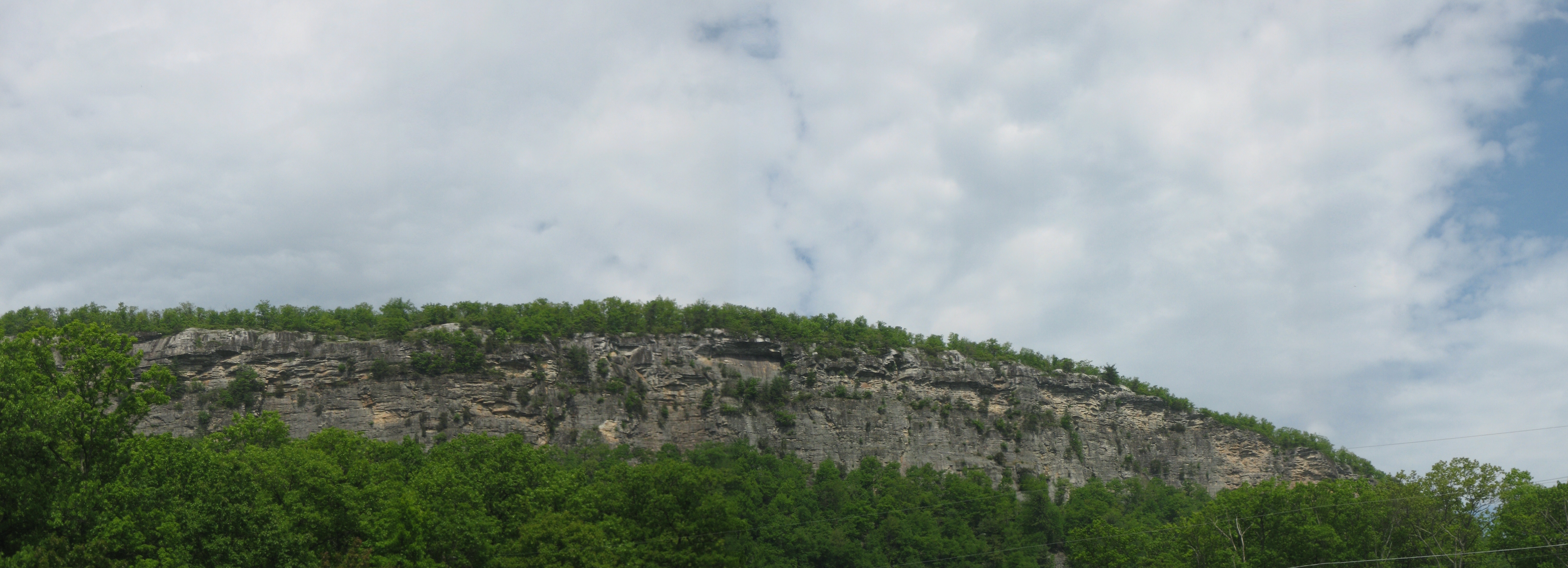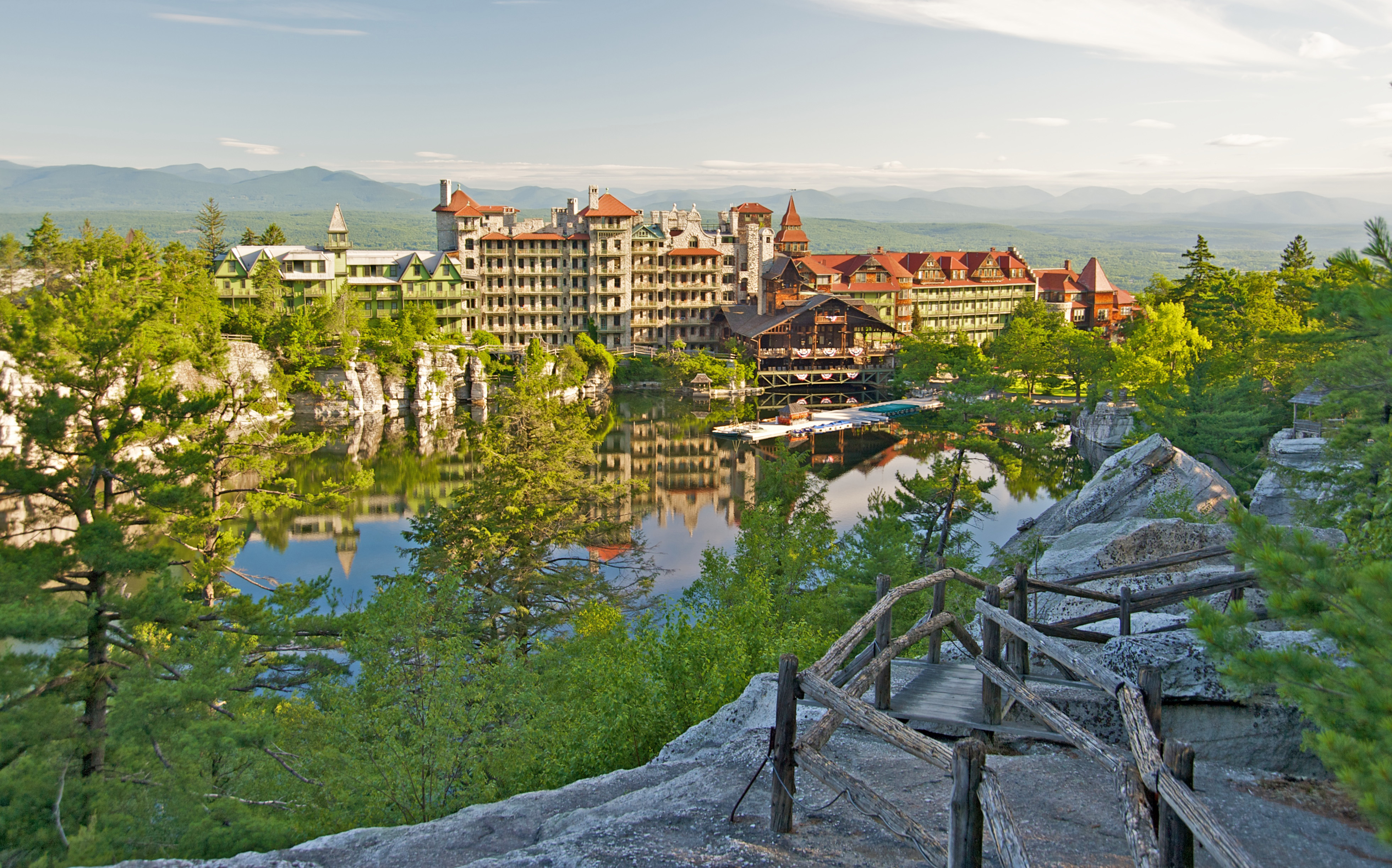
The drive up to Mohonk Mountain House climbs the access road called Mountain Rest Road through a gatehouse, past a small lake, around a series of switchbacks, and emerges, after several minutes of forest, at the long lakefront facade of a Victorian castle resort. White-grey Shawangunk quartz cliffs rise behind it. Lake Mohonk, glacial and dark, sits in front of it. The building is not subtle: turrets, gabled roofs, crenelated towers, wrought-iron balconies, Adirondack-style verandas running the length of the lakeshore. Inside, one hundred and fifty fireplaces and six hundred rocking chairs. It is large in the way that summer hotels of a certain era — White Mountain, Adirondack, Victorian Catskill — used to be large. It is, by some measures, the last of them.
The address is 1000 Mountain Rest Road, New Paltz, NY 12561. It has been operating in some form since 1869.
That is the building. The argument is what surrounds it.
The 1869 ten-room inn
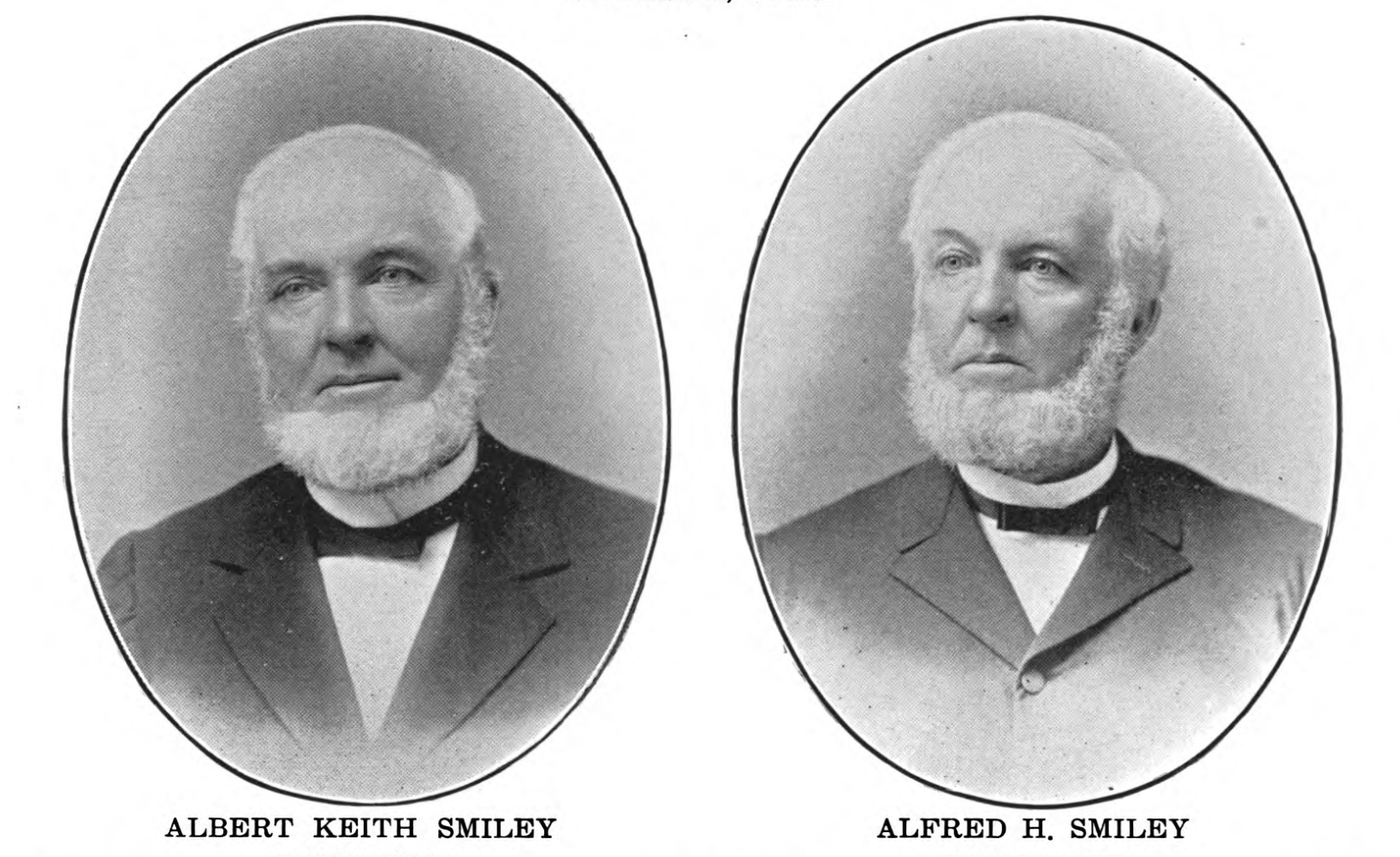
In 1869, Albert K. Smiley and his twin brother Alfred H. Smiley — Quakers, schoolteachers, both Maine-born — bought a small, ten-room inn on the shore of Lake Mohonk and two hundred and eighty acres of surrounding land for $28,000. The inn already existed under a different owner. The Smileys took it over and started expanding.
The expansion ran in earnest from 1879 to 1902. The architects of record were Napoleon Le Brun and James E. Ware, working in stages. Native stone and timber. Victorian, Gothic, and Queen Anne motifs hybridized into a single long lakefront mass. The central building dates to 1888. By the early twentieth century the inn had become the resort, and the resort had become the institution.
Albert Smiley lived to 1912; his younger half-brother Daniel Smiley ran the property through the entrepreneurial expansion years. Daniel built the carriage roads. The carriage road system, started in 1871 under Albert and continued by Daniel, eventually grew into more than seventy miles of crushed-stone roads and forty miles of trails — the network that, as much as the building itself, is what guests come for.
The Mohonk Lake Cooperative Weather Station, on the property, has logged daily records since 1896. One hundred and thirty years of continuous climate data, kept by the family, on the same lake.
The six generations
The Smiley family has run Mohonk continuously across six generations in a straight, named line:
- Albert K. and Alfred H. Smiley (1869) — the twin founders.
- Daniel Smiley (1855–1930) — Albert's younger half-brother, the entrepreneurial expander.
- Bert, Francis, Mabel, and Rachel Smiley — early-twentieth-century operations, with Mabel Craven Smiley running housekeeping and employee relations.
- Daniel Smiley (1907–1989) and Keith Smiley (1910–2001) — Daniel established the natural-science research program; Keith founded Mohonk Consultations on environmental issues.
- Albert K. "Bert" Smiley III (1944–2018) — President and CEO from 1990 to 2018.
- Eric Gullickson (President) and Tom Smiley (CEO) — cousins, the current sixth-generation leadership.
That is the inheritance line. Each generation has run the property. No private equity, no sale, no rebrand — even after a century and a half of the kind of pressure that would have liquidated almost any comparable property.
The 1963 hundred dollars
This is the spine.
In February 1963, Mabel Craven Smiley — by then in her seventies, having served the property's third-generation operations for decades — wrote a check for one hundred dollars to a small new entity she and the family had established: the Mohonk Trust. The Trust's purpose was to safeguard the landscape outside the resort's own acreage. To make the surrounding land — the Gunks, the cliffs, the carriage roads east of the property line, the broader Shawangunk Ridge — inalienable.
A hundred dollars. From Mabel. In 1963.
The Mohonk Trust grew across the next fifteen years through additional family contributions, donor support, conservation easements, and outright land acquisition. In 1978, the Trust was renamed and restructured as Mohonk Preserve, Inc. — a separate nonprofit, financially independent of the hotel, with its own board, its own staff, and its own mission. The hotel and the preserve are not the same organization. They share a road.
The Mohonk Preserve today is eight thousand two hundred acres. New York State's largest nonprofit nature preserve. Three hundred thousand annual visitors. Fifty thousand climbers a year. More than a thousand established rock-climbing routes. Forty-two state-rare species. All of it is a chain that begins, in any honest reading, with that one hundred dollars.
The reason this is the spine — and not the building, not the founders, not the dining-room terrace — is that almost no comparable Victorian summer resort survived because almost all of them eventually monetized their land. Most of the great Catskill and Adirondack hotel properties of Mohonk's vintage were liquidated, subdivided, sold to developers, or burned. The land they sat on became condos, second-home plots, golf courses, casinos. The resorts went away because the land that made them was treated as inventory.
Mohonk did the inverse. It kept the building, and removed the surrounding land from the market entirely. Six generations later, the building is still operating because the view it sells is the view it cannot itself extract from.
What the property is now
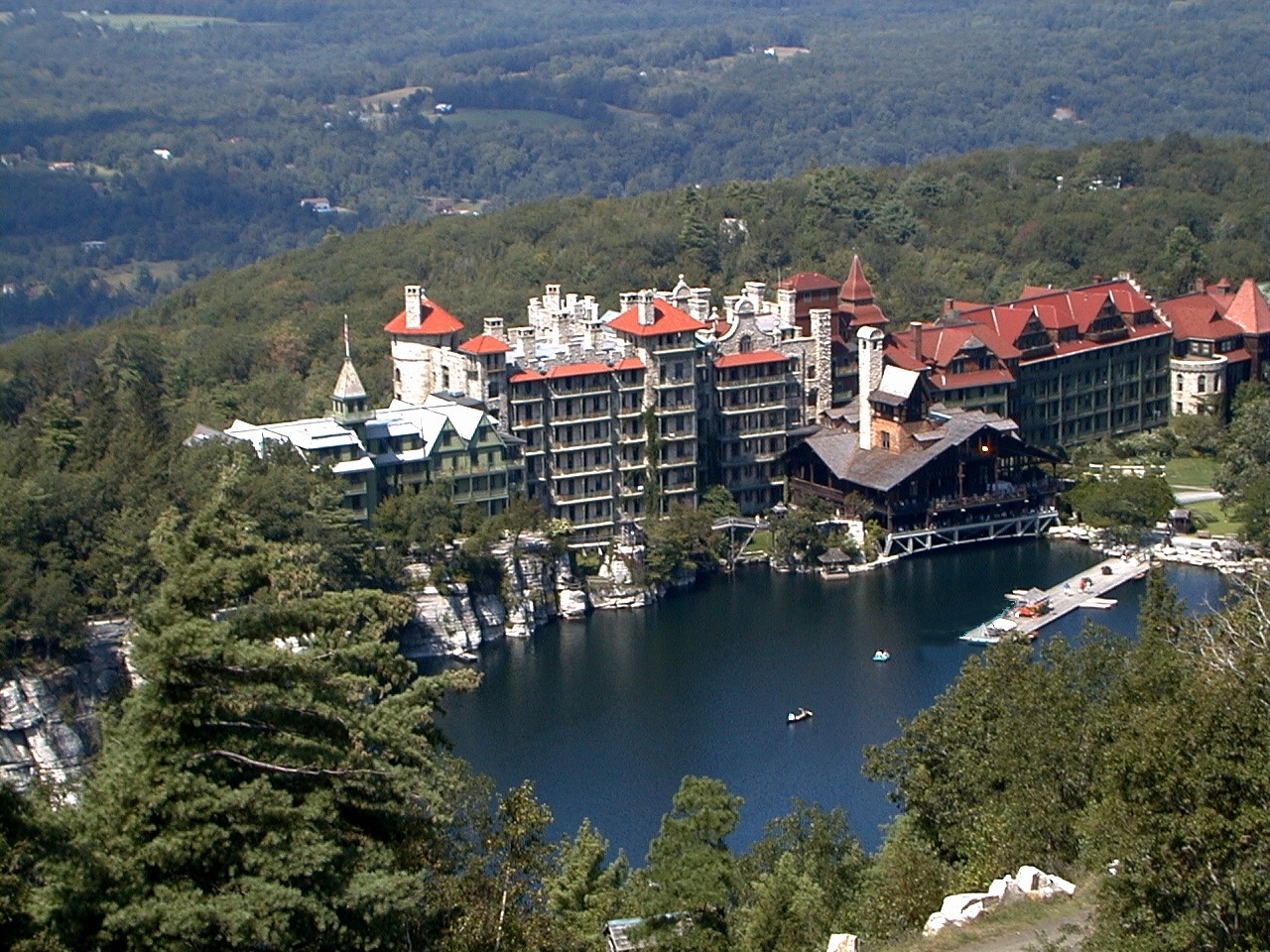
The hotel proper is 259 guest rooms, including 28 in the central tower wing. The architecture has been added to but not stripped — original 1893 woodwork still anchors the Main Dining Room, which seats with cathedral ceilings and panoramic Catskills views and continues to operate on the Full American Plan (rate includes accommodations, three meals daily, afternoon tea and cookies, and most activities). Dinner reservations are mandatory. Resort Casual is the dress code.
The other public rooms hold their period: the Lake Lounge, Founders, the Carriage Lounge (Mohonk's first cocktail lounge, opened in 2005), the library, the parlor, the Old Fashioned Soda Fountain, the Granary, Spirits on the Porch, and the Chef's Table for tasting-menu dinners.
Afternoon tea and cookies, served daily overlooking Lake Mohonk, is the signature ritual of the property and the part of the day a great many returning guests have planned around for fifty years.
The activities
The schedule reads like a 1925 brochure on purpose.
Golf. A vintage nine-hole course laid out on the property's high terraces. Tennis. Hard and clay courts. Ice skating on Lake Mohonk since 1934, with an indoor pavilion (opened 2001) for shoulder-season use. Lake swimming, kayaking, canoeing. Horseback riding along the carriage roads. Hiking on the network of seventy-plus miles of carriage roads and forty miles of trails. Wellness programming in the spa wing (a 30,000-square-foot building added in 2005). The Via Ferrata, opened in 2024, taking guests up the Shawangunk cliffs on a fixed-cable assisted climbing route — a contemporary addition that fits because the cliffs were always there.
Skytop Tower — the property's most photographed asset. Built in 1923 as a memorial to Albert Smiley after his 1912 death. Conglomerate stone, eighty feet tall, 1,542 feet above sea level, three hundred feet above the surface of Lake Mohonk. A 1.5-mile carriage road climbs to it from the main hotel. From the top of the tower on a clear day, the view reaches the mountains of six states — New York, New Jersey, Pennsylvania, Vermont, Massachusetts, and Connecticut. The tower turned a hundred years old in 2023.
The themed weekends and continuous traditions are part of how the property holds. The Illumination of the Mountain — a Fourth of July ritual in which the hotel staff plant kerosene-fed flambeaux along the carriage roads at dusk and the silhouette of the resort burns visible from the valley below — has been done since 1900. Garden Lovers' Holiday since 1935. Mystery Weekend since 1977. None of these are events the marketing department invented in 2018.
The honors
The property is a National Historic Landmark (designated June 24, 1986), on the National Register since 1973, and a member of Historic Hotels of America. It received the United Nations Environment Award in 1994. Condé Nast Traveler has named it the #1 Resort in the Mid-Atlantic in two consecutive years. Travel + Leisure lists it among the top resorts in New York State. The Spa is on Condé Nast Traveler's top-25 resort spas in North America list.
These are the kind of awards that follow operations. They do not produce them.
What "protected its view" means
The argument is simple.
A hotel sells, fundamentally, a view. A bed is a bed; a meal is a meal; the experience that distinguishes a resort from a generic accommodation is the outside of the room. The mountain. The lake. The cliff. The forest. That is what guests pay for.
Most resort operators, when given the opportunity, eventually try to monetize the view itself. Build more rooms with the view. Build adjacent condominiums. Sell off the buffer land to developers who will build their own properties next door. The view becomes inventory, and inventory becomes leverage, and leverage becomes — eventually — sale, decline, demolition, replacement.
Mohonk's six generations did the inverse. They removed the view from the inventory. The eight thousand two hundred acres that make Lake Mohonk Lake Mohonk are owned by the Preserve, not the resort. They cannot be sold by the family. The family cannot leverage them. No future Smiley can liquidate the buffer. The hotel operates on 1,325 acres. The view operates on 8,200. The arrangement is structural.
That is why Mohonk is still Mohonk in 2026 and most of its 1869 peers are not.
What the rest of the valley can learn
Three things.
One. The most valuable thing a property owns is sometimes the thing it does not own — the land it has chosen, structurally, to put out of its own reach. The hotel that owns its view also owns the option to build on it. The hotel that has given the view to a separate non-profit cannot.
Two. Multi-generation operating decisions compound in ways that single-decade decisions do not. Mabel's hundred dollars in 1963 is not measurably valuable as a check. It is enormously valuable as the start of a sixty-three-year structural decision. The Hudson Valley has many properties that could make this kind of decision. Almost none have.
Three. Resort Casual, Full American Plan, the Illumination of the Mountain since 1900 — the prescriptive non-modernity of Mohonk is not nostalgia. It is operational discipline. Guests come because the property does not drift toward whatever current hospitality fashion is selling. The dress code, the dining room, the schedule, the rocking chairs, the fireplaces, the carriage roads, the tea — none of these are upgraded for novelty. They are continued because they work.
Go, then come back
Mohonk Mountain House is at 1000 Mountain Rest Road, New Paltz, NY 12561 — about ninety minutes from Manhattan, twenty minutes off the New York State Thruway. Full American Plan; rates include three meals, tea, and most activities. Day-use access is also possible (with reservation) for guests who want the carriage roads and the dining room without the overnight.
Walk the carriage roads to Skytop. Take afternoon tea on the porch overlooking the lake. Sit on the dining-room terrace through a sunset. Skate the lake in February. Climb the Via Ferrata in October. Sit in one of the six hundred rocking chairs and read a book.
Then, on the way out, look at the gatehouse, look at Mountain Rest Road, look at the long-protected acreage either side of you, and remember that none of it was guaranteed to still be here. A hundred dollars in 1963 is what is here.
— The Editors