The intersection at the center of the village of Rhinebeck is the same intersection it has been for two hundred and sixty years.
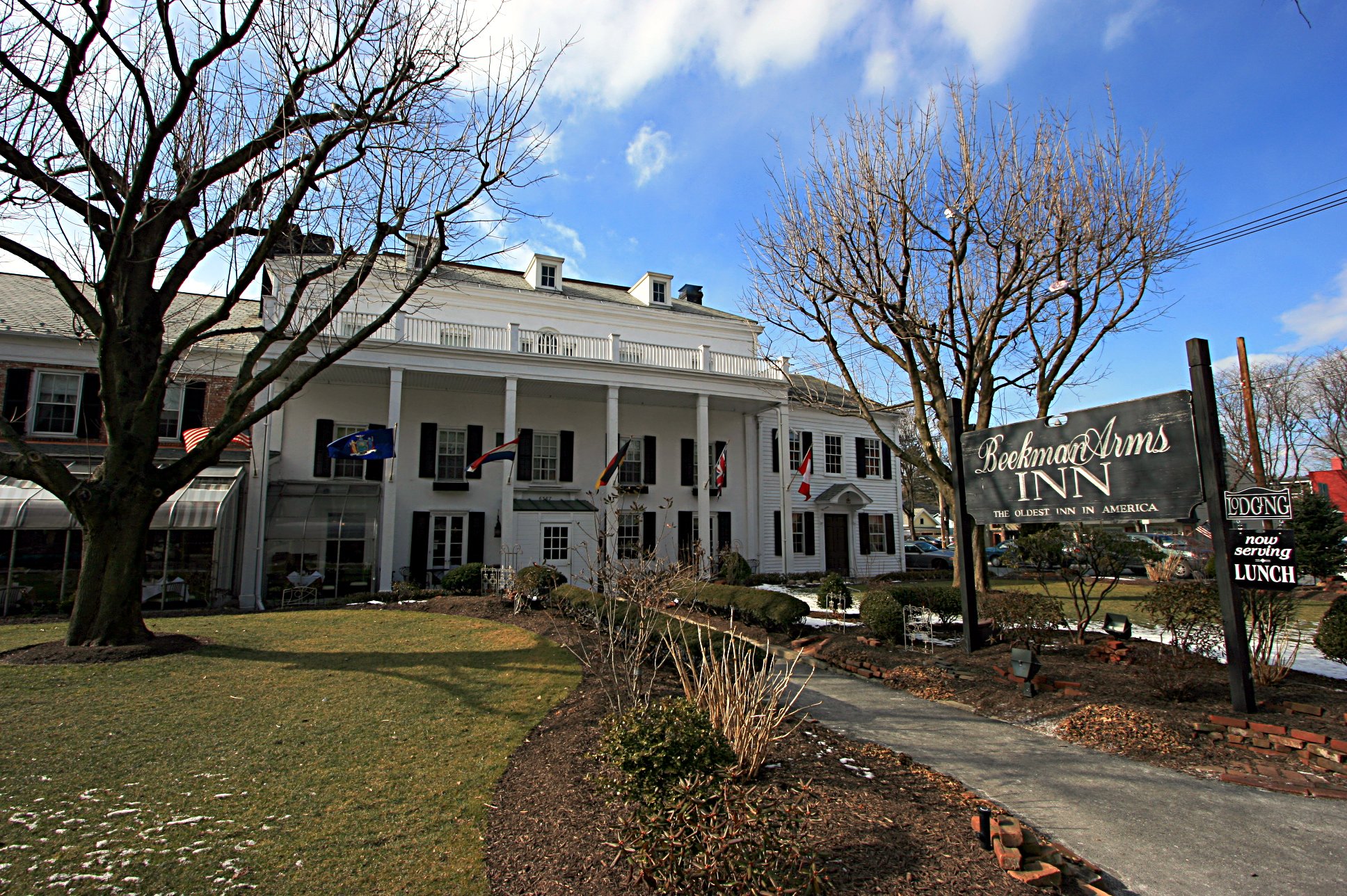
Mill Street meets East Market. The northwest corner is the Beekman Arms, a clapboard inn with a deep wraparound porch, low-ceilinged tavern, hand-hewn beams, and the kind of gravity small American buildings used to have when the Republic was new. George Washington stopped there. FDR concluded each of his four political campaigns — for governor twice and for president twice — speaking from the front porch. The inn has rooms above the tavern, a restaurant in the original 1766 dining room, and a complex of restored heritage buildings (the Delamater House of 1844, the Germond House, the Carriage House) along Montgomery Street that operate as additional inn lodging.
It is, by widespread agreement, America's oldest continuously operating inn.
That is the village's spine. Everything else in Rhinebeck — the heritage estates along the Hudson, the wealth that flowed in from them, the village core, the design overlay that keeps chains off the four central blocks — is the consequence of one inn that did not close.
The 1766 building
In 1704, William Traphagen built Rhinebeck's first tavern at the intersection of the King's Highway (now Route 9) and the Sepasco Trail. The tavern operated through three generations of the Traphagen family. In 1766, William's grandson Arent (Aaron) Traphagen rebuilt the inn at the current site in heavy timber and stone — built, by some accounts, to withstand attack — at a moment in which the political weather was already shifting toward the Revolutionary War. The 1766 rebuild is the operational-continuity start. The inn has not closed since the year of the Stamp Act crisis.
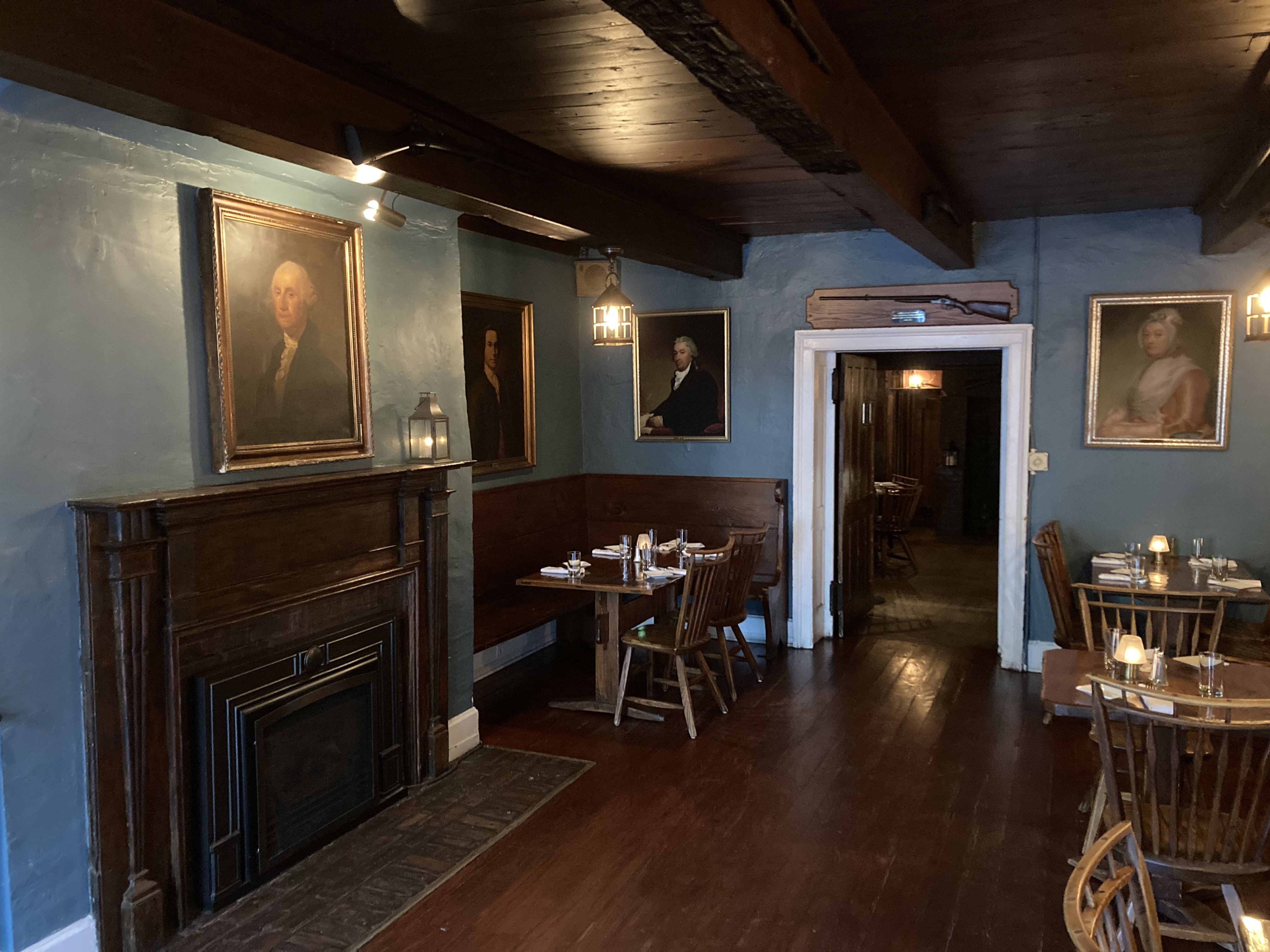
The architecture is what it has been since the rebuild: clapboard exterior, deep wraparound porch, low ceilings, original beams in the tavern, second-floor rooms reached by a creaking staircase. The address is 6387 Mill Street. The inn is on the National Register of Historic Places in its own right, and inside the boundaries of the much larger Rhinebeck Village Historic District.
The political detail that does the most editorial work happens in the spring and fall of 1804. During the bitter New York gubernatorial race — Aaron Burr versus Morgan Lewis — Lewis camped at the Beekman Arms and Burr was down the street at the Kip Tavern. The political insults that ricocheted between the two camps fed the broader feud that, four months later, ended on the dueling ground at Weehawken. The Beekman Arms hosted, in plain terms, one half of the political quarrel that killed Alexander Hamilton.
The detail that does the most modern editorial work happens a hundred and thirty years later. FDR's Hyde Park home was twelve miles south. He concluded each of his four campaigns — two for governor of New York, two for president of the United States — speaking from the Beekman Arms front porch. That porch is, in the most precise sense, the most consequential American political stage that survives at its original address.
The inn was acquired in 1958 by Charles LaForge Jr., who has kept the LaForge family in stewardship of the property for the contemporary era. In 1979, he and his partner Timothy Toronto acquired and restored the Delamater House — a Carpenter Gothic 1844 design by Andrew Jackson Davis — and built out the adjacent Courtyard Complex, which is how the inn now operates as the Beekman Arms & Delamater Inn.
The estates
The patronage that surrounded Rhinebeck did not arrive at the village. It arrived at the river. The wealthy New York families who built country estates on the Hudson cliffs above and below the village — the Astors, the Livingstons, the Millses, the Suckleys — set the tone of Rhinebeck without setting up shop in it.
Ferncliff — William Backhouse Astor Jr.'s 1853 founding, expanded under John Jacob Astor IV (Stanford White's 1902 sports pavilion included one of the first indoor pools in the United States), inherited by Vincent Astor after JJA IV's 1912 death on the Titanic. By 1940 the estate was 2,800 acres. Brooke Astor donated 192 acres of it in 1964 to the Rhinebeck Rotary as Ferncliff Forest — forever wild.
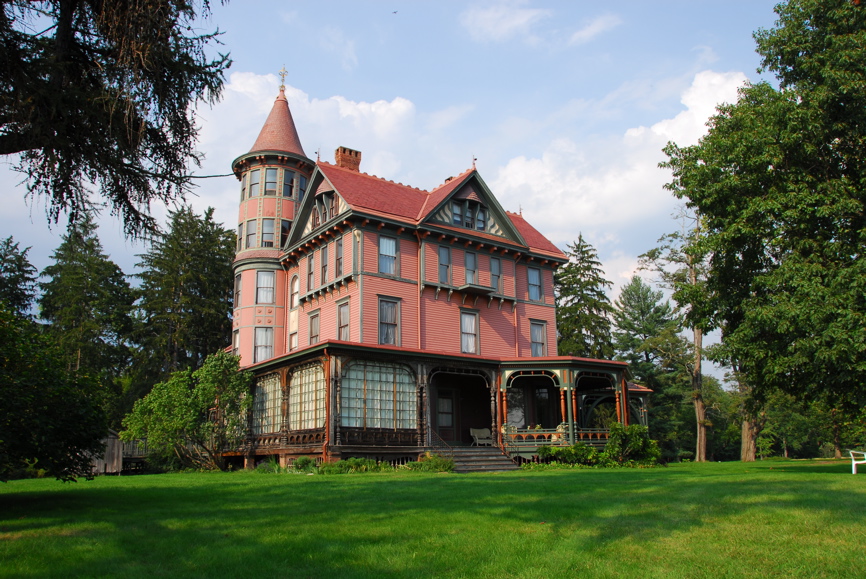
Wilderstein — the Suckley family's Italianate-then-Queen-Anne home, built 1852 and expanded 1888, on a high bluff over the river. Birthplace and lifelong home of Margaret "Daisy" Suckley (1891–1991), distant cousin and lifelong confidante of Franklin Roosevelt. She gave him Fala. She was at Warm Springs the day he died. The letters between them were found in a suitcase under her bed after her death in 1991. The estate is now publicly accessible.
Staatsburgh (the Mills Mansion) — a 65-room Beaux-Arts country house remodeled 1895–96 by McKim, Mead & White for Ogden Mills and Ruth Livingston Mills. Ruth Livingston Mills had set out to dethrone Caroline Schermerhorn Astor as the doyenne of New York Society and built Staatsburgh as her route to the throne. She did not seize it. The house remains, as a New York State Historic Site, the most architecturally complete monument to the attempt.
Montgomery Place in nearby Annandale-on-Hudson — built 1804–05 by Janet Livingston Montgomery for her late husband, the Revolutionary War general Richard Montgomery; expanded by A.J. Davis in the 1840s into what is widely considered Davis's finest neoclassical country house. Acquired by Bard College in 2016.
Edgewater in nearby Barrytown — 1824 Federal-style by John R. Livingston, refurbished by A.J. Davis in 1854. Gore Vidal owned it. He sold it to Richard Hampton Jenrette in 1969 for $125,000. Jenrette spent decades restoring it, recovering original furnishings, and added a classical pavilion and pool house in 1997. It is now owned by the Classical American Homes Preservation Trust he founded.
These estates did not absorb the village. They sat at the river, half a mile away, and let the village be the village.
The village
The village of Rhinebeck — the four-block walkable core of Mill Street, Montgomery, East Market, and West Market — is roughly 2,700 people. The surrounding Town of Rhinebeck is about 7,500. The village is 1.6 square miles. The Rhinebeck Village Historic District, listed on the National Register since August 8, 1979 and expanded in 2021, contains roughly 577 contributing buildings.
The legal architecture that keeps Rhinebeck Rhinebeck is worth naming, because it is the most replicable thing about the place. The Village's zoning code includes a "special sensitivity" overlay district along Route 9 that requires new residential construction to "preserve the appearance of a single detached dwelling" and requires businesses in covered areas to "not be operated in a way to make it outwardly appear that they are a business." The chains, the strip-mall pressure, the box-store gravity that has flattened so many small Hudson Valley village centers — Rhinebeck has not banned them. It has zoned them. The chains live on the south end of Route 9, where the gas stations and the Stewart's are. The village core is for independents because the village said so, in writing, in 1979.
That is how a 260-year-old inn ends up still being the centerpiece of a working main street.
What's around it now
The contemporary village reads as operators who have stayed long enough to compound.
Le Petit Bistro at 8 East Market opened in 1986. Joseph and Jennifer Dalu took over in 2000 and have run it as French country since. Terrapin at 6426 Montgomery, in a renovated 1825 First Baptist Church, opened at this address in 2003 — chef-owner Josh Kroner has been at it since, with multiple Hudson Valley Magazine "Best Of" wins and a Wine Spectator Award of Excellence. Bread Alone opened the Rhinebeck café in 2000 — a satellite of Dan Leader's 1983 Boiceville bakery; carbon-neutral, wood-fired hearth, renovated 2023. Little Goat on Mill Street (which we have written about).
Oblong Books at 6422 Montgomery — Hudson Valley's largest independent bookstore. Founded by Dick Hermans and Holly Nelson in Millerton in October 1975; the Rhinebeck location opened in 2001. Now run by Dick and his daughter Suzanna.
Upstate Films at 6415 Montgomery — independent nonprofit cinema, founded 1972 by Steve and DeDe Leiber with Susan Goldman, with $5,000 borrowed from parents. Across fifty-three years, seven thousand titles screened to two-and-a-half million viewers. The founders stepped down in 2021. The nonprofit continues. This is the cultural institution, more than any other, that has made Rhinebeck cinematically literate.
Williams Lumber — Stan Williams bought Gibson Lumber on East Market in 1946. Eighty years on Route 9.
Bard College's Fisher Center for the Performing Arts — Frank Gehry's first building in the Northeast, opened 2003, 107,000 square feet of stainless-steel cladding "that undulates to mimic the Hudson Valley's rolling landscape," in Bard's own description. Eight hundred-seat concert hall, two hundred-seat theater. Bard SummerScape and Bard Music Festival pull through into Rhinebeck restaurants, hotels, and rentals every July and August.
The Old Rhinebeck Aerodrome — founded 1958 by Cole Palen as America's first flying museum of antique aircraft. Pioneer-era through Golden Age aircraft, all flyable, still flown.
The Dutchess County Fair — founded 1842, in Rhinebeck since 1919. Six days every August. Half a million attendees a year. Second-largest county fair in New York State.
What "the 1766 inn" means
The argument is structural.
A village that built itself around an inn — a single building that has continuously offered food, shelter, and a porch to walk onto for two hundred and sixty years — has a center that the village did not have to invent. The Beekman Arms is older than the United States. It is older than every president, every New York governor, every Hudson Valley railroad, every chain restaurant in America. The village did not build toward a center. It built around one that was already there.
That single fact does a tremendous amount of work over time. The streets had to fit the inn. The shops had to fit the streets. The estates of the wealthy had to sit a half-mile away because the village core was already taken. Two hundred and sixty years in, the village core still belongs to the inn, and the inn still anchors the village core, and neither has been allowed to drift toward what the rest of America's towns drifted toward.
What the rest of the valley can learn
Three things.
One. The center of a village is the building that stays. The Beekman Arms is the village's clock. Two hundred and sixty years of continuous operation is what produced everything around it — the four-block walkable core, the design overlay, the independent operators who outlasted the chain pressure. Continuous operation is the unit of value.
Two. Wealth shapes a village by what it doesn't try to do to it. The Astors, Livingstons, Suckleys, Millses sat at the river and built monumentally — but they did not move into the village core. The patronage flowed; the residential geography did not. A village that is not absorbed by its wealthy hinterland keeps a working main street. A village that is, doesn't.
Three. Zoning is editorial. Rhinebeck's "special sensitivity" overlay is, in a real sense, a prose document — "shall not be operated in a way to make it outwardly appear that they are a business" is sentence-level zoning. The village that wrote that sentence into its code has the village it has now. Most villages did not write the sentence. Most villages do not have the village.
Go, then come back
Rhinebeck is roughly two hours north of Manhattan. Take Metro-North to Poughkeepsie or drive the Taconic. Park in the village, walk Mill Street to the Beekman Arms, sit on the porch, eat in the tavern dining room. Walk Montgomery to Oblong Books, Upstate Films, Terrapin, Le Petit Bistro, Bread Alone. Drive out to Wilderstein in good weather; the lawn faces the Hudson and is one of the more underrated heritage views in the valley. Bard's Fisher Center if SummerScape is on. The Dutchess County Fair in late August. The Aerodrome for the WWI air shows in summer.
Then drive home, past whatever village center you happen to pass through, and ask: what is the building at the middle of this town, and how long has it been there? That is the case for Rhinebeck. And, quietly, it is the case for everywhere in the valley that has had a center long enough to build a town around it.
— The Editors