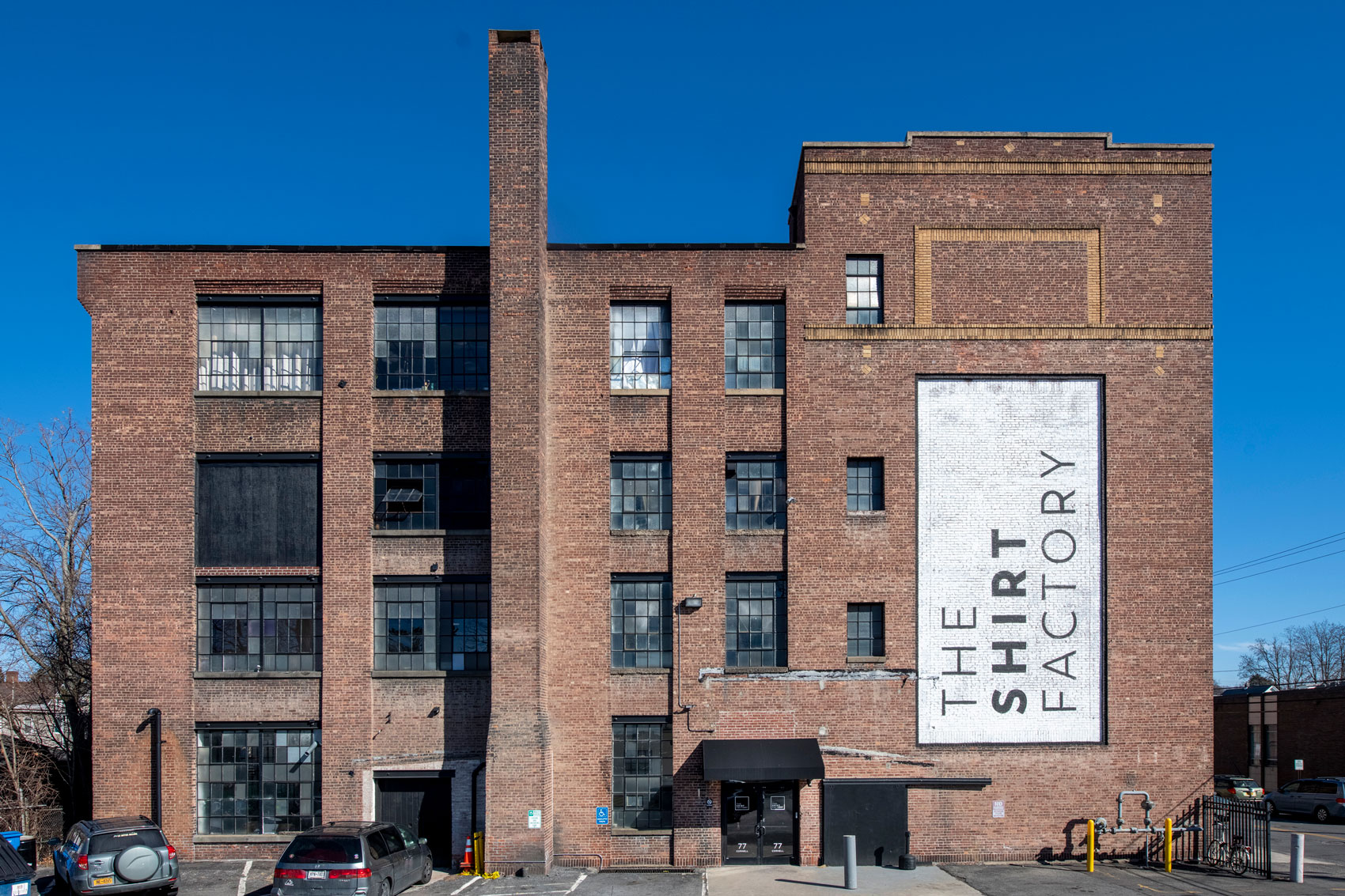
If you stand on Cornell Street in midtown Kingston and look up at 77 Cornell, what you see is a four-story brick industrial building with the word FACTORY still legible on its skin. The bones are 1917. The ceilings inside are thirteen feet. The brick is exposed because it always was. The hardwood beams are the original sawn timber. Roughly sixty-five thousand square feet of working interior. Roughly sixty working artist studios inside it.
This is The Shirt Factory. It is the cornerstone of Kingston's Midtown Arts District (MAD). And it is the most legible answer in the valley to the question, what does adaptive reuse actually look like when it works?
The 1917 building
In February 1917, F. Jacobson & Sons — a shirt manufacturer with factories in New York, New Jersey, Delaware, and Maryland — opened a new building on Cornell Street in Kingston. At opening, it was reported as the largest factory in New York State. The spec was state-of-the-art for industrial textile work in the early twentieth century: full-building sprinkler and fire safety, an employee cafeteria, an employee dance hall. (The dance hall was for the workers. There were many, many workers.)
The Hudson Valley's local garment industry, of which Jacobson was a piece, once employed thousands. Kingston's role in that industry — manufacturing-led, working-class, unionized — is a chapter that is sometimes overlooked in favor of the Stockade District's Dutch-stone tourism narrative, but it is the chapter that explains why a building of this scale exists in midtown at all. By the late twentieth century the industry had largely left the region and the building had largely emptied. By the early 2000s, artists were already, in some cases, squatting it.
The 2002 bet
In 2002, Mike Piazza — a Kingston-based developer whose father was a painter — bought the Shirt Factory.
The artists already inside the building shaped what Piazza chose to do with it. Rather than convert to apartments, or to office, or to demolish-and-rebuild, he committed the building to artist-tenant rental preference and started the long, slow rehab of running 65,000 square feet as working studios. The 13-foot ceilings, the column spacing, the natural north light from the original factory windows — all of which had been engineered for sewing-floor work in 1917 — turned out to be uncannily well-suited to painting and ceramics and printmaking and photography in the twenty-first century. The factory was already a studio building. Piazza just gave it the right tenants.
Over the following two decades he added two more buildings to the same model: The Brush Factory (101 Greenkill Avenue, a former clothes-brush factory now operating as live/work artist lofts plus makers, manufacturers, and a spa) and The Pajama Factory (49 Greenkill Avenue, apartments plus design and art studios). Together, the trio runs roughly 140,000 square feet of artist-rental-preference industrial space inside MAD.
Piazza, on the record, on what the model has been:
"I have a symbiotic relationship with the artists. I'm very happy with the mix of talented young tenants and the bright, energetic stuff they're doing."
"It's very fulfilling to have the opportunity to create something — you make a painting and someone buys it, it's a thrill that someone would be interested in your work — the same thing applies to real estate."
That second sentence is the model's whole thesis: a building, like a painting, is an object you make. Adaptive reuse is the practice of finishing a building somebody else started, with a different problem in mind. Piazza is not a preservationist. He is a developer. The point of the building is not to be preserved. It is to function.
The studios
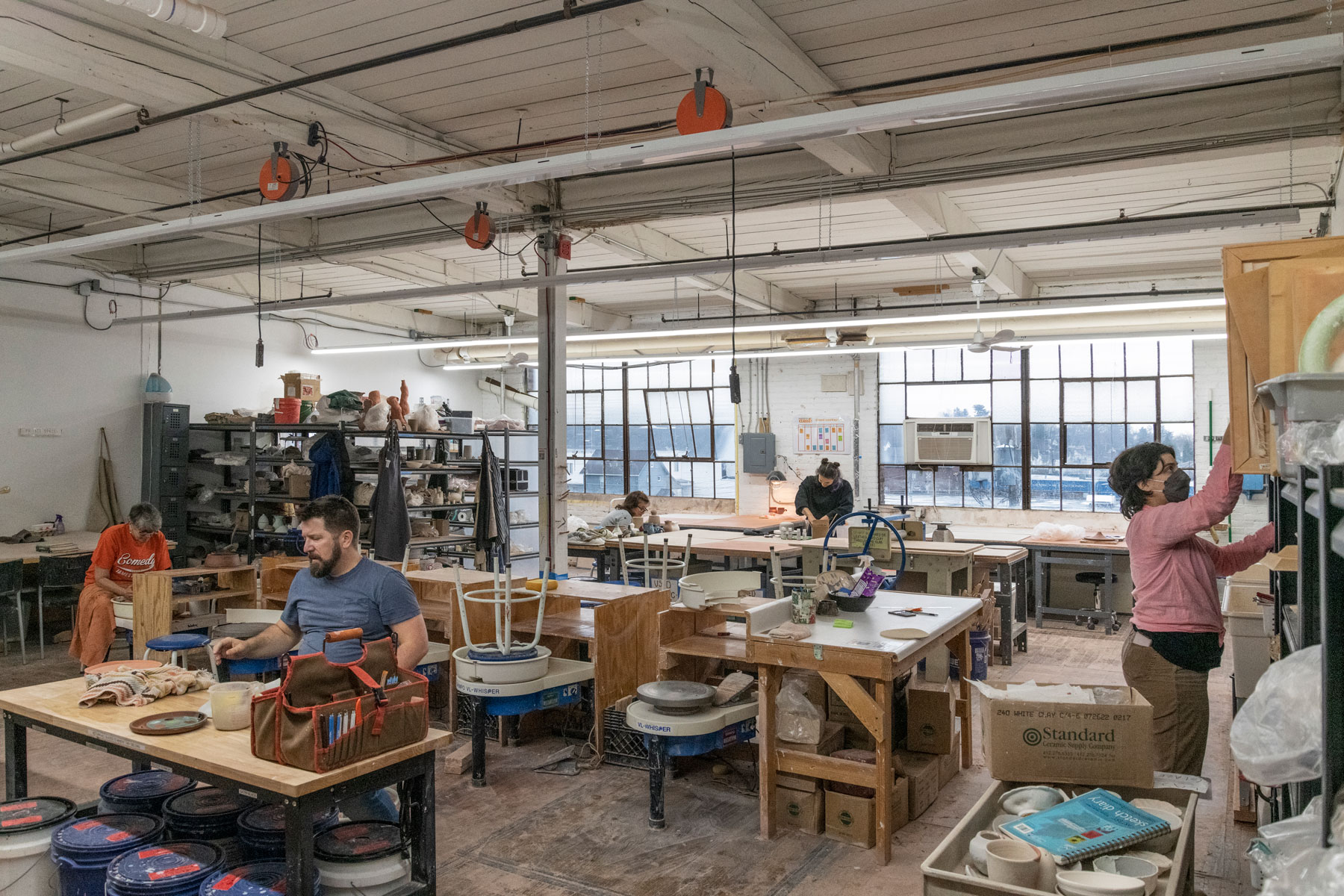
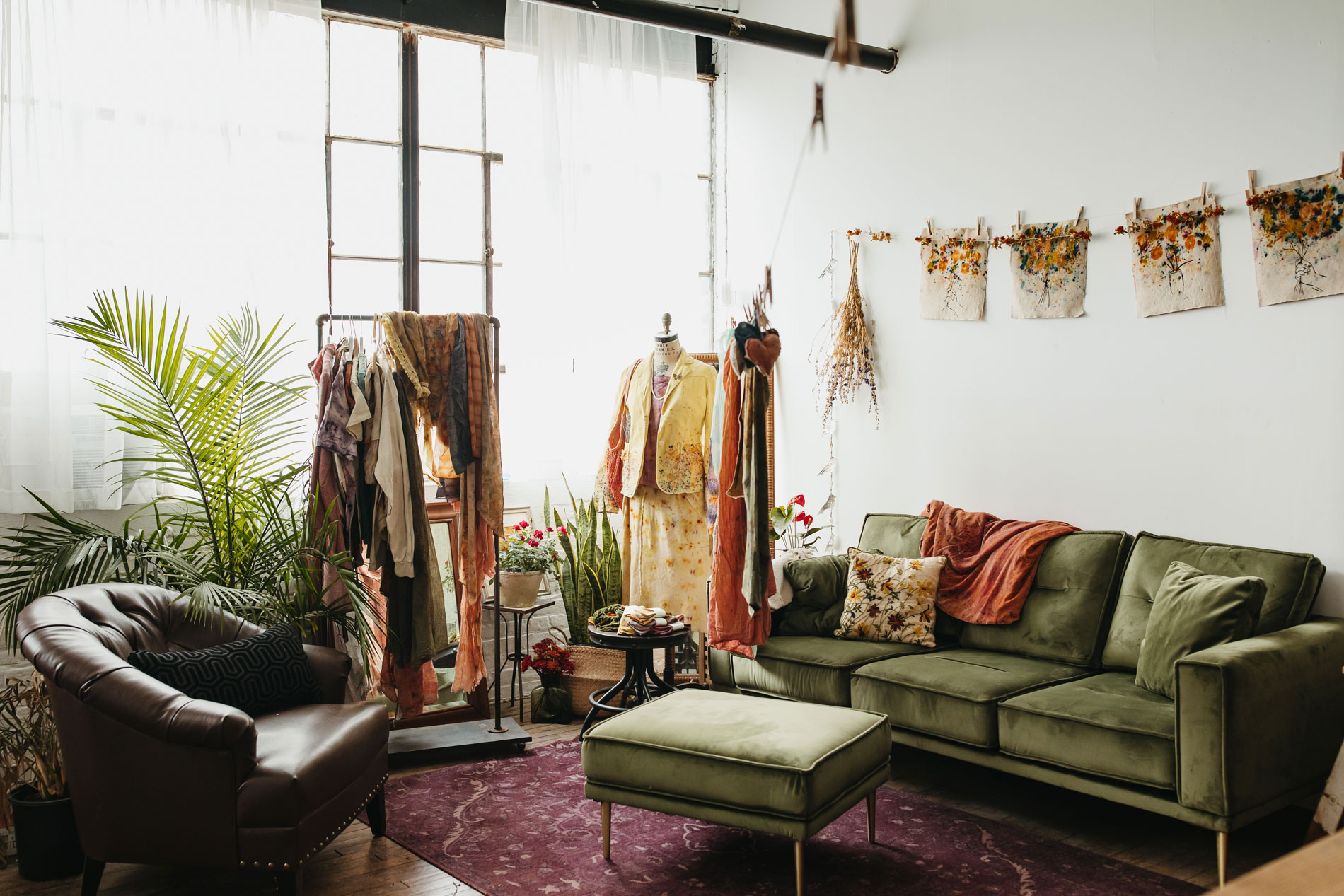
Inside the Shirt Factory today: roughly sixty working studios. Painters. Photographers. Filmmakers. Printmakers. Ceramicists. Textile artists. Musicians. The mix shifts year over year because the studios are working — the people in them are making and selling work, sometimes growing out and moving up, sometimes staying for a decade, sometimes stopping by from out of town to use a residency week. The building's directory at thekingstonfactories.com is the working list.
Two anchor operations are worth naming because they are the public-facing way most visitors meet the building.
Kingston Ceramics Studio, run by Alexis Feldheim, is a teaching pottery operation inside the Shirt Factory — drop-in classes, multi-week intensives, and the kind of hands-on access that turns "I've always wanted to try wheel-throwing" into a Saturday afternoon.
Demetria Chappo, a ceramicist whose Hudson Valley studio is also inside the Shirt Factory, makes hand-built and wheel-thrown work — sculptural and functional — and teaches private classes including outdoor pit-firing. (Her wall-hung Xora landscapes were in the powder room of the 2025 Kingston Design Showhouse, covered by Chronogram. Her weekly hand-building classes also run at Wildflower Farms in Gardiner, the Auberge resort that opened in 2022.) Her work is in the lineage of potters who came up through theatre and design before clay — she has a BFA in Actor Training and 10+ years of teaching pedigree from Brooklyn pottery schools (Clayworks on Columbia, Educational Alliance, Bklyn Clay, Artshack) before landing at the Shirt Factory.
If you have ever wanted to learn to throw a pot, or to wheel-build, or to fire one in an open pit on a Hudson River morning — this is the building.
The programming
The Shirt Factory's public programming is the building's other half. Periodic building-wide Open Studios open every door on every floor; the centennial event in September 2017 ran the full version (open studios + performance art + pop-up galleries + a historic exhibit on the building's 1917 origins) and that has been the template since. Pop-up shows. Tenant-run classes. The kind of access where a visitor on a Saturday afternoon can meet six artists in their working spaces in the time it would take to walk a museum gallery.
Kingston's broader adaptive-reuse arc is the relevant context. Hutton Brickyards on the Kingston riverfront — a vacant industrial complex turned open-air market, event venue, and now a hospitality property — is one. Stockade Works, Mary Stuart Masterson's film and TV production nonprofit, is another. Kingston Wharf is the next chapter being written. Each of those projects is doing a different version of the same calculation: what does this building know how to be? The Shirt Factory's answer has been the same since 2002. A place where things get made.
What "kept making things" means
The argument is simple.
A great many old industrial buildings in the Hudson Valley have been preserved. A smaller number have been rehabbed. A smaller number still have been programmed — meaning a developer has made a deliberate, long-running bet on what the building should be used for now, and built the leasing model and the tenant mix and the public programming around that bet.
The Shirt Factory's bet, made in 2002 and held to since, is that the same building can keep making things. The people inside have changed. The stuff being made has changed. The economic logic — manufacturing for export in 1917, art and craft and small-run production for a regional and national market in 2026 — has changed. The building's purpose has not. Things go in raw, things come out finished. Workers are paid. The building is full.
That is what adaptive reuse is supposed to be when it succeeds.
What the rest of the valley can learn
Three things.
One. A building's highest use is rarely its first use, but it is rarely its prettiest use either. The Shirt Factory is not glamorous. The Brush Factory and Pajama Factory are not glamorous. The point is not for them to be photogenic. The point is for them to operate.
Two. Artist-tenant preference is a long bet. Studios are not the highest rent per square foot a developer could charge in midtown Kingston in 2026. They are the rent that produces the tenant mix that produces the programming that produces the building's identity — which is what produces the long-run real estate value. Piazza has held this for twenty-three years. The buildings are full.
Three. The Hudson Valley has more 1900s industrial building stock than it has tenants for it. The arithmetic does not work without a programming model. Preservation alone empties buildings. Programming fills them. The Shirt Factory is the legible Kingston example. There are dozens of candidates across the valley still waiting for their version of 2002.
Go, then come back
The Shirt Factory is at 77 Cornell Street, Kingston. Watch the Open Studios calendar at thekingstonfactories.com — a building-wide open day is the right way to meet the place. If you are even pottery-curious, book a class with Kingston Ceramics Studio (Alexis Feldheim) or with Demetria Chappo (private and small-group, including outdoor pit-firing). Walk the four floors. Look up at the thirteen-foot ceilings. Note that the brick was already there in 1917.
Then look at every other empty industrial building you pass on the way out of town and ask: what is this still capable of making? That is the case for the Shirt Factory. And, quietly, it is the case for everywhere in the valley with a building that has not yet found its second purpose.
— The Editors