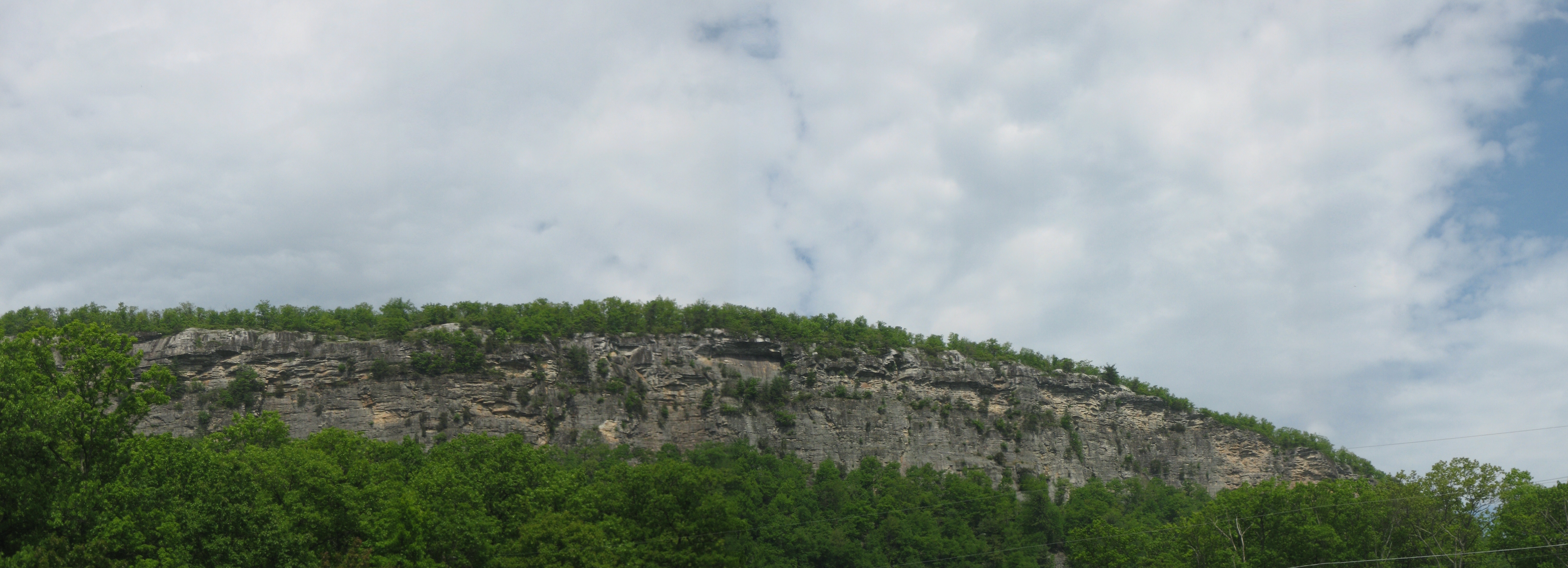
The road into New Paltz climbs slowly out of the Wallkill River basin and the Shawangunk Ridge rises in front of you, white-grey quartz conglomerate cliffs that look, from a distance, like a wall someone built. They are not a wall. They are one of the most biodiverse landscapes east of the Mississippi — the Nature Conservancy lists them among its "Last Great Places on Earth" — and they have been continuously protected, by private hands, for more than a century and a half. That is not the only thing in New Paltz that has stayed itself for a long time. That is what this town is about.
The street
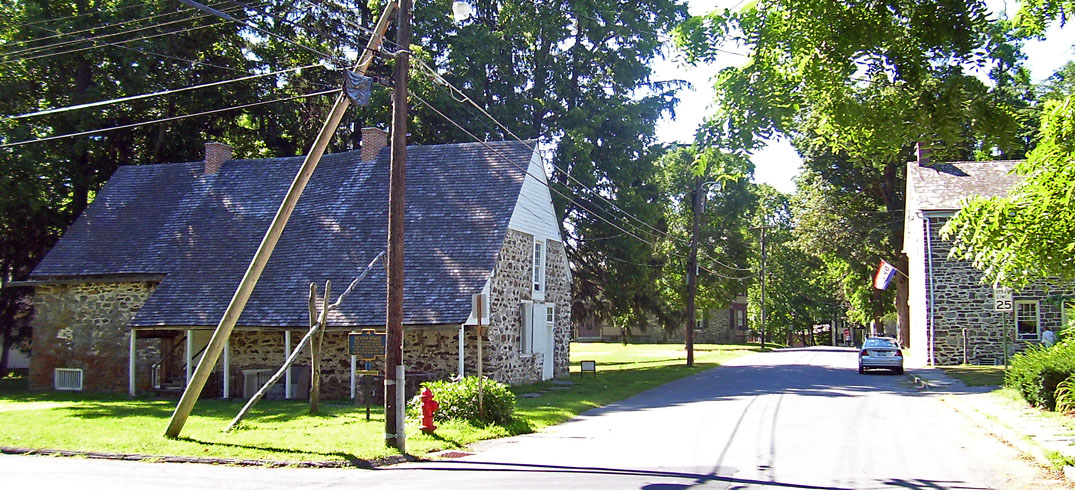
Walk three blocks west of the village's Main Street and you reach Huguenot Street. This is what it is. In 1677–78, twelve French Huguenot families — Bevier, Crispell, Deyo, DuBois, Freer, Hasbrouck, LeFevre, and others, refugees from religious persecution — pooled their resources, received a forty-thousand-acre patent from the colonial government, and built the bank of the Wallkill into a small settlement. By the early 1700s, seven of those families had built stone houses. Those seven stone houses still stand. They are still on the original street, on the original foundations, with the original walls.
It is, by widespread agreement, the oldest continuously inhabited street in America with its founding-era buildings still in place. The district was designated a National Historic Landmark in 1960 and now covers ten acres along the river. Bevier-Elting, Jean Hasbrouck, Abraham Hasbrouck, DuBois Fort, Deyo, LeFevre, Freer.
Twelve families pooled to buy 40,000 acres in 1677. Their descendants founded a museum in 1894 to keep the street they built. The street is still there.
The descendants
This is where the spine starts to come into view. In 1894 — almost two and a half centuries after the patent — the descendants of the twelve founding families incorporated themselves as the Huguenot Patriotic, Historical, and Monumental Society and bought the property of their ancestors back. The institution, now known as Historic Huguenot Street, is among the earliest descendant-run preservation societies in the United States. It has been running for a hundred and thirty-one years. The board still includes representatives from each of the twelve original families. The walking tours are still given on the same street. None of this is a state preserve. None of it is a public park. It is a private inheritance, formally organized, voluntarily maintained.
That is the first act of stewardship.
The castle
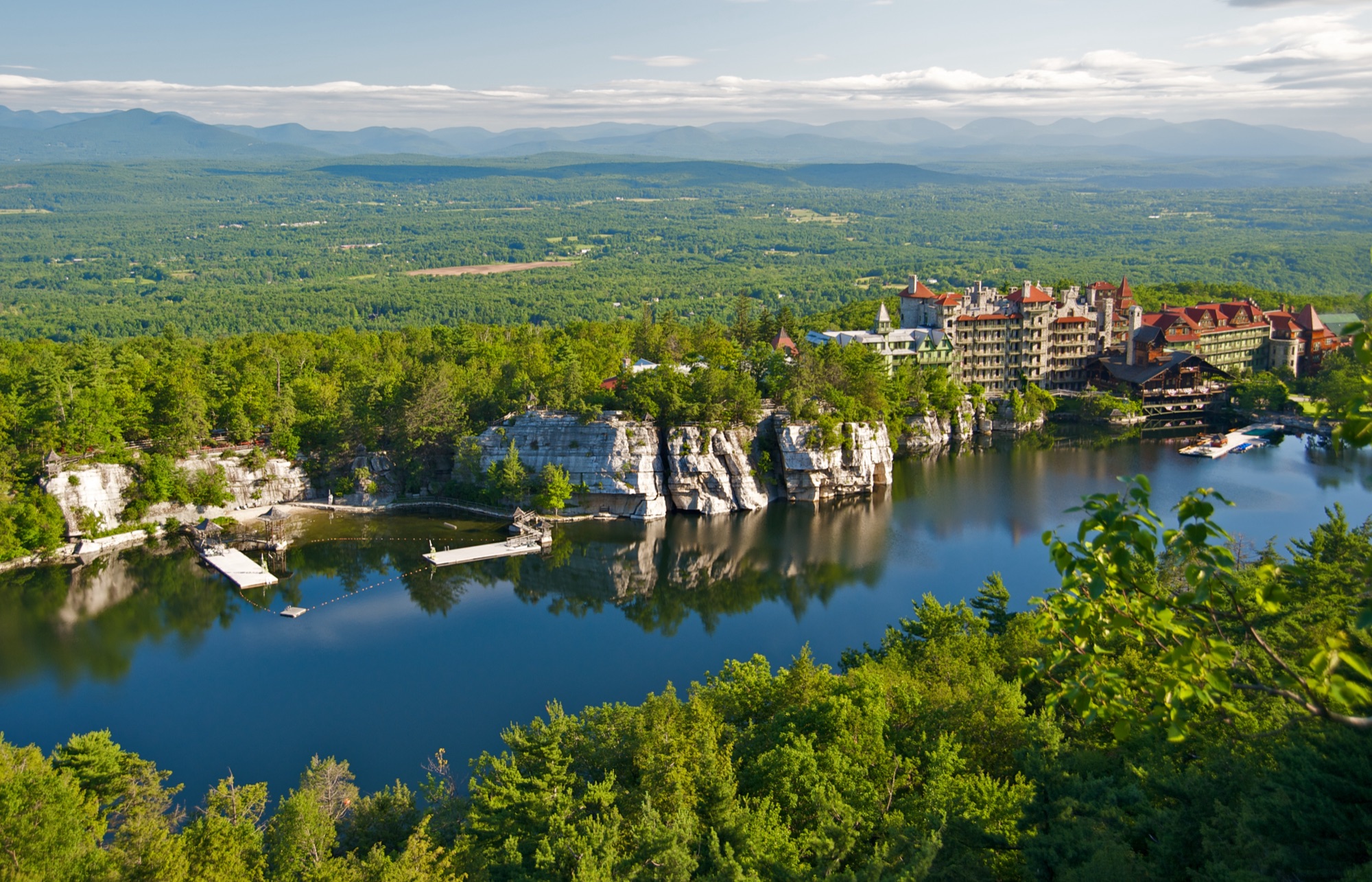
Two miles west of the village, on a glacial lake at the foot of the Shawangunk cliffs, is the second.
In 1869, twin Quaker brothers, Albert and Alfred Smiley, bought a ten-room inn on Lake Mohonk and 280 surrounding acres. Over the next four decades they expanded the inn into a hundreds-of-rooms Victorian castle resort — turrets, gabled roofs, lake-side terraces — that has been continuously owned and operated by six generations of the Smiley family since. The contemporary property is Mohonk Mountain House, with 259 guest rooms; the family still runs it. The original lake shore, the original terrace, the original carriage drive, are still where they were in 1900.
That is the second act.
The preserve
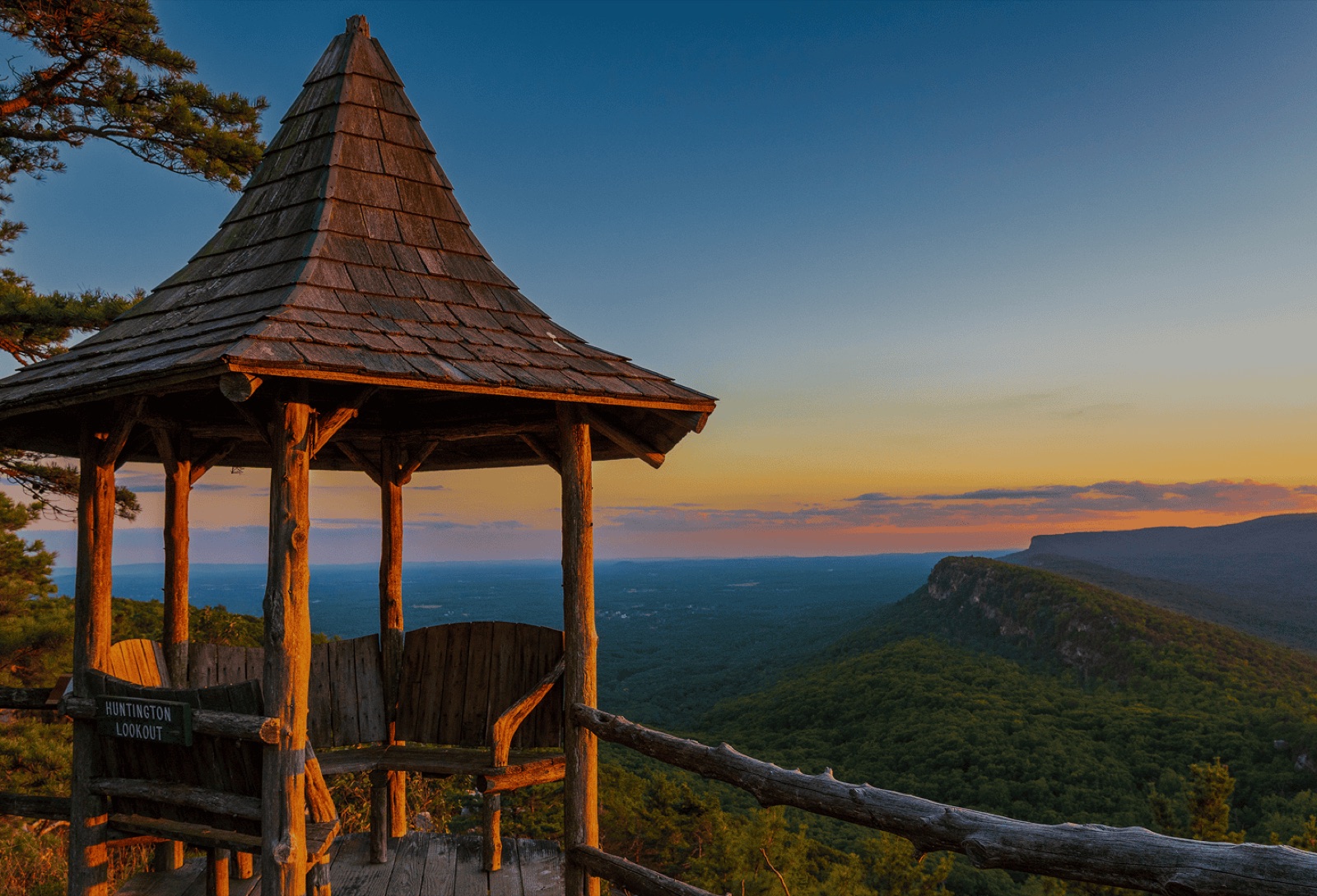
In 1963, Mabel Smiley made a founding gift that established the Mohonk Trust — a small nonprofit charged with stewarding land around the family's resort. Over the following sixty years, the trust grew into the Mohonk Preserve, New York State's largest nonprofit nature preserve. Eight thousand acres. Three hundred thousand annual visitors. Fifty thousand climbers a year. More than a thousand established rock-climbing routes. Forty-two state-rare species. Forty-two state-rare species.
Adjacent to it, Minnewaska State Park Preserve holds another 23,974 acres of Shawangunk ridge — four sky lakes (Minnewaska, Awosting, Maratanza, Haseco), thirty-five miles of carriage roads, fifty miles of hiking trails. Together, the protected ridge stretches for more than thirty thousand acres above the village.
That is the third act of stewardship.
What "inherits its stewards" means
The argument is simple. Most American towns where the historic core is intact owe that intactness to a state government, a federal preservation grant, or a tourist-board rebrand. New Paltz owes its intactness to twelve families, a Quaker family, and a family member's nineteenth-century gift. The institutions that maintain the most important things in the town — the street and the ridge — are descendant-run, family-run, or trust-run.
The town inherits, voluntarily, the people willing to keep things working.
What's around it now
The contemporary chapter sits inside this older frame. Main Street in the village holds an independent ecosystem: Main Street Bistro (long-running breakfast/lunch institution), Inquiring Minds Bookstore at 6 Church Street (and a Saugerties location), Water Street Market (twenty-plus independent shops, sculpture garden, free Monday movies). Recent openings include Sideshow (BBQ, Brian Keenan + Craig Gioia, summer 2024), Underground Coffee & Ales (April 2024), Butterhead Salad Co. (second location, November 2024), Art Attelier at the former Unison space (December 2024), Agave at 53 Main, and Melted (grilled cheese).
Coppersea Distilling at 239 Springtown Road runs traditional small-batch spirits. Whitecliff Vineyard is on the Shawangunk Wine Trail. Mountain Brauhaus at the foot of the Trapps is the climbers' canteen. The Wallkill Valley Rail Trail, twenty-three-and-seven-tenths miles on a former railroad corridor, runs through the village and now forms the spine of the Empire State Trail through Ulster County.
SUNY New Paltz — founded in 1828, today around six thousand undergraduates — is the engine of the year-round economy. Median home prices have moved into the high six figures since 2020. None of this is a coincidence.
What the rest of the valley can learn
Three things.
One. Stewardship is durable in a way that ordinances are not. A zoning code can change with an election. A descendant-run nonprofit, an eight-thousand-acre trust, a six-generation family business — those are operations that survive election cycles, market cycles, even tourism cycles. The valley has more land than it can preserve through public action alone. The intact examples are almost always private.
Two. Specificity beats charm. "A pretty Hudson Valley town with a historic street" describes many places. "The town with seven 1700s Huguenot stone houses run by descendants since 1894, the Smiley family's six-generation Victorian castle resort on Lake Mohonk, and an 8,000-acre preserve founded by a 1963 gift" describes one. Specifics are a brand.
Three. The most valuable inheritances are operational, not architectural. Historic Huguenot Street is not just a row of buildings — it is a functioning museum with full-time staff, a published research program, and a board that meets. Mohonk Mountain House is not just a Victorian shell — it is a 259-room operating hotel. The Mohonk Preserve is not just protected land — it is a thousand-route climbing area, a research station, a nonprofit with a budget. Operating institutions outlive preserved buildings. The valley should learn the difference.
Go, then come back
New Paltz is roughly an hour and a half from Manhattan. Walk Huguenot Street in the morning — the seven stone houses, the 1717 Walloon Church reconstruction, the burying ground. Drive up to Mohonk for lunch on the dining-room terrace looking out over the lake. Walk the carriage roads to Skytop. Climb at the Trapps if that's a thing you do, or hike the Trapps if it isn't. Take Springtown Road back into the village for dinner — Main Street, Sideshow, the Brauhaus.
Then drive home. Look at any town in the valley you happen to pass through and ask: who is keeping this working, and how long will they? That is the case for New Paltz. And, quietly, it is the case for everywhere else in the region that is being inherited, voluntarily, by the people who refuse to let it lapse.
— The Editors