The block
186 Main Street. A corner store at the eastern end of New Paltz's commercial spine, with a green awning, a glass door, a deli case in the window, and the kind of unassuming storefront you walk past three times before you notice you've already been inside. The town hall is a few blocks west. The bars are a few blocks west of that. SUNY New Paltz is a ten-minute walk up Plattekill Avenue. The middle school is literally five doors away, on the same side of the street: New Paltz Middle School, 196 Main Street. Roughly two hundred feet between the deli's counter and the middle school's front door.
That geographic fact does most of the work of this piece. The deli sits exactly in the pedestrian corridor between New Paltz's two big youth populations. It has sat there, in some form, since the Ford administration.
There are a lot of delis on Main Street in a lot of college towns. There is only one corner store, on this block, that has been the New Paltz deli for fifty years.
The deli the town defined
1975 — the storefront opens under Gary Haas. This is the period for which the documentary record is thinnest; what survives is the address itself and the form: cold case, hot grill, breakfast sandwiches, sandwiches by the half-pound, cigarettes, lottery, the kind of corner store that's the same shape in Brooklyn as in Buffalo as in a Hudson Valley college town. The shape is the institution. The shape is what the building has been since Ford was president.
1985 — a young art student named Kathy Fizzel arrives at SUNY New Paltz to study fine art. She gets a job working the counter at Convenient Deli her first semester. She is twenty years old. The job is supposed to be a college job.
1998 — Fizzel buys the deli from Gary Haas.
She is thirty-three. She has worked behind the counter for thirteen years. The transaction is not glamorous. It is the next step in the relationship she's been building with the building since freshman year. She will run the deli as proprietor for the next twenty-two years.
By the time Fizzel sells the deli in 2020, she has been associated with it for thirty-five years — longer than most people stay anywhere. She has watched two generations of SUNY students cycle through; she has watched faculty marry their students; she has watched the middle school next door change principals four times. She becomes one of those people the town defines itself through without ever quite saying so. (When local press profiles her in 2024, after she's left the deli, her career change to running an Ulster County scuba operation is treated as a New Paltz story.)
This is the period that gives the building its weight. A single proprietor staying long enough that her tenure becomes load-bearing for the block. The town's sense of "the deli" — the deli, definite article, the one — gets built across her thirty-five years.
The deli each generation redefines
January 15, 2020. Fizzel sells the deli to Khalil Jamal.
Jamal is a SUNY New Paltz graduate. That fact is the single most important thing to know about him for the purposes of this story. He came to New Paltz as a student, finished his degree, and bought the corner store five doors from the middle school. He is, by the logic the block has been operating under since 1985, the natural next owner.
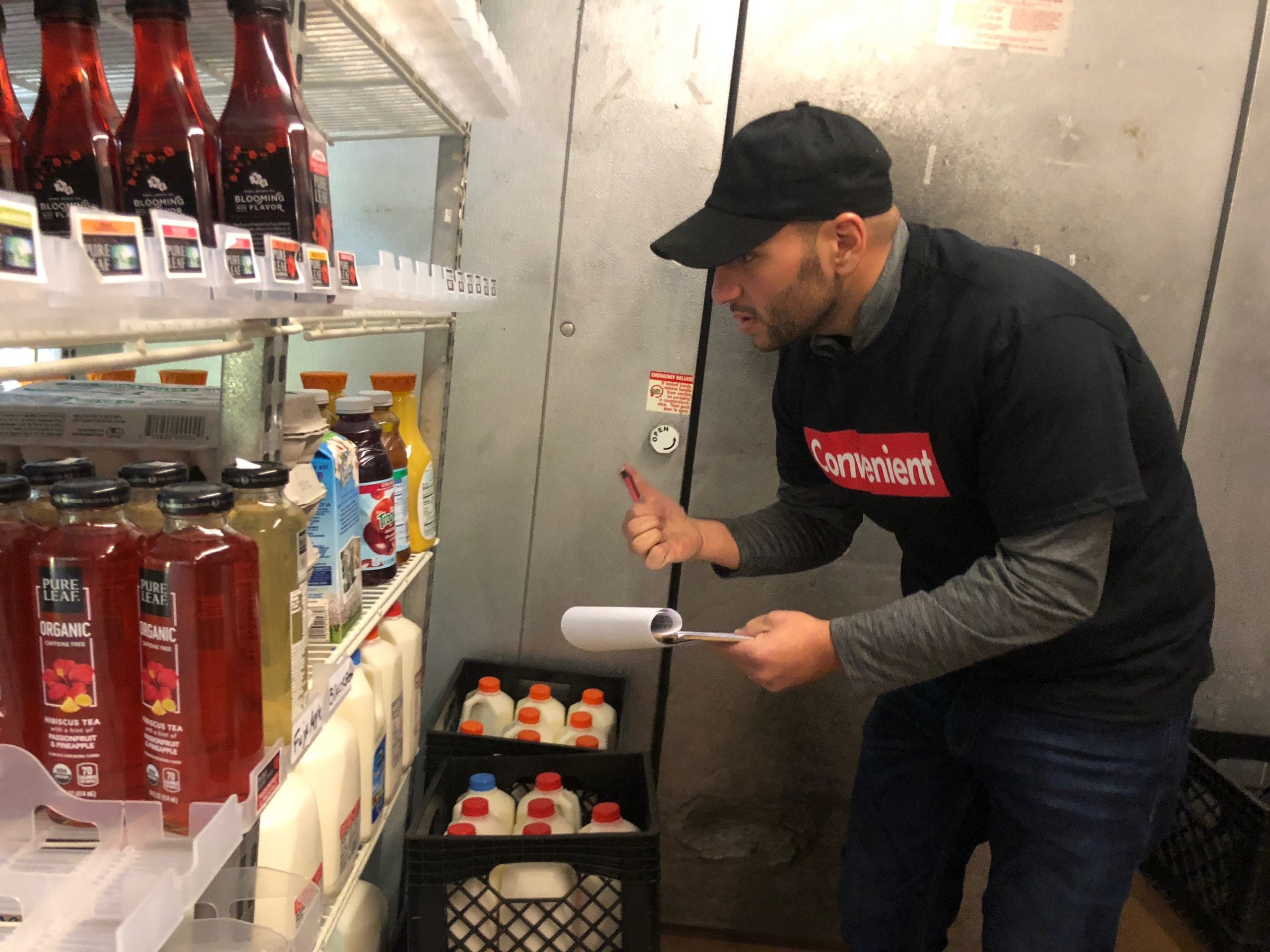
He operates the deli with three of his brothers — Sayeed, Sharif, and Amar. It's a family business now, four brothers running a corner store in a Hudson Valley college town. That's a different scale of operation than a single proprietor. It's also a different cultural footprint. The food shifts. The kitchen brings on NYC-style halal — chicken gyro plates, rice plates, the menu items that mark a corner store as part of the broader downstate deli vocabulary. The breakfast sandwich list expands. The cold case gets reorganized. The signage gets cleaner. The awning rolls out the new name: Convenient Deli & Cafe.
In April of 2024, after a renovation, the deli reopens to coverage in the regional press as the "iconic New Paltz deli." (That word — iconic — is theirs, not ours. Hudson Valley Country's headline.)
What it carried into the reopening, mostly intact, is the form the building has had since 1975. What it added is the new owner's vocabulary. That's the redefinition. The deli is the form; each generation of New Paltz brings its own contents.
The form, served New Paltz–style
Walk through the door at 186 Main today and the layout is the layout the building has had for half a century, give or take. Counter on the left. Hot grill in the back. Cold case along the right wall. Snacks and lottery and the necessary corner-store inventory in the middle. The room is small enough that there's a line out the door at lunch.
The food the room serves now:
- Breakfast — bacon-egg-and-cheese on a fresh roll, breakfast sandwiches on bagels, the entire BEC family of corner-store grammar. Open at 6 AM. The grill closes at 2.
- NYC-style halal — chicken gyro plates, rice plates, the food that announces the new ownership the way the chalkboard menu used to.
- The deli case — Italian sandwiches, BLTs, grilled chicken wraps on white, wheat, spinach, or tomato-basil. The list is the list a corner deli's list has been since 1975, with a few of the wraps that the 2010s added.
- The $6.47 sandwich-of-the-day special — sandwich, side, and a fountain drink. (The New Paltz Oracle's Top Ten Eateries list cited this exact price.) The kind of pricing that announces who the deli is for: students, schoolkids, the people who walk to lunch.
- The convenience side — chips, ice cream, snack cake, hummus and pita, fountain drinks. The store half of corner store.
The grill closes at 2 PM, on the days when it opens at 6 AM, because that's the rhythm the building has had since the form was invented. Breakfast first. Lunch into the early afternoon. After-school traffic for the cold case and the snacks and the fountain drinks. The point is that the room is open when it matters for the populations it serves — the middle school five doors away, the college ten minutes up the road, the village walking past the door.
The longer arithmetic
The longer arithmetic on Convenient Deli — the calculation that earns the article's headline — is this:
The same building has been the same deli on the same block for fifty years. Three owners. All three came to New Paltz first as students. Gary Haas, the first generation. Kathy Fizzel, the SUNY art student who ended up there for thirty-five years. Khalil Jamal, the SUNY graduate who came back with three brothers and a halal kitchen.
That's not a story about a deli. That's a story about a college town's relationship with its own onboarding device. The kind of corner store that takes in people who arrived in town for some other reason — to study, to teach, to be young somewhere — and quietly converts them into people who stay. Each owner brings their own decade's New Paltz with them. Each one redefines what the deli is, by being a slightly different person standing behind the same counter.
The building has been there longer than most of the people who walk past it have been alive. It will be there longer than most of the people who walk past it now will live in the town. Somewhere on the campus up the road there is probably already a freshman, this fall, who will end up buying it.
That's the case for the New Paltz deli.
— The Editors